Sustainable development
🎯What you need to be able to do
- Explain the meaning of sustainable development.
- Explain the Sustainable Development Goals (SDGs) and use them to discuss a country’s progress.
- HL Explain the relationship between sustainability and poverty.
📚The economics
The meaning of sustainable development
The standard definition comes from the Brundtland Report (1987): development that meets the needs of the present without compromising the ability of future generations to meet their own needs. It has three connected dimensions:
rising incomes and productive capacity that can be maintained, not based on running down non-renewable resources or unsustainable debt.
reducing poverty and inequality; access to health, education, decent work; inclusion and fairness within and between generations.
using renewable resources no faster than they regenerate, limiting pollution to what ecosystems can absorb, protecting biodiversity and the climate.
Growth measured by GDP can be unsustainable: clearing a forest for timber and plantations adds to GDP now but destroys natural capital, carbon storage and future livelihoods. Sustainable development asks whether a country’s total stock of capital — physical, human, social and natural — is being maintained.
The Sustainable Development Goals
Adopted by all UN member states in 2015, the 17 SDGs set targets for 2030, succeeding the Millennium Development Goals (2000–2015). They apply to all countries, rich and poor, and combine the three dimensions:
1 No poverty; 2 Zero hunger; 3 Good health and well-being; 4 Quality education; 5 Gender equality; 6 Clean water and sanitation.
7 Affordable and clean energy; 8 Decent work and economic growth; 9 Industry, innovation and infrastructure; 10 Reduced inequalities; 11 Sustainable cities and communities.
12 Responsible consumption and production; 13 Climate action; 14 Life below water; 15 Life on land; 16 Peace, justice and strong institutions; 17 Partnerships for the goals.
Each goal has specific targets and indicators (for example, SDG 1’s target of ending extreme poverty, measured against the international poverty line). Progress is uneven: many countries are off track, with the pandemic, conflicts and food and energy price shocks having reversed some gains. When discussing progress, use data for two or more countries on a few chosen goals (4.10).
Evaluation of the SDGs: they create a shared framework, focus attention and data collection, and include rich countries. But there are many goals and targets, some conflict (growth versus climate action), they are not legally binding, and financing gaps are large.
Sustainability and poverty HL
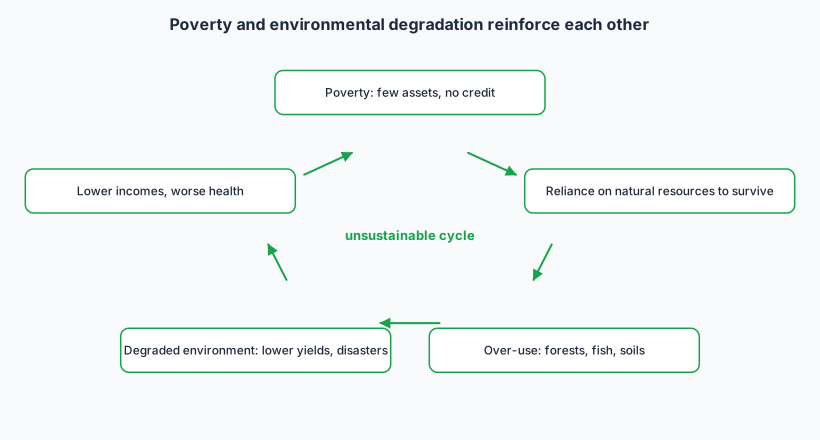
- Poverty can cause unsustainable resource use: poor households with no savings, credit or insurance depend directly on natural resources — firewood, fishing, grazing, slash-and-burn farming — and cannot afford to think long-term. Short time horizons lead to over-exploitation of common pool resources.
- Environmental degradation deepens poverty: the poor depend most on ecosystems and live in the most exposed places (flood plains, coasts, degraded land). Soil erosion lowers yields; overfishing cuts catches; climate change brings droughts, floods and rising seas, which hit the poorest hardest. Indoor air pollution from cooking with wood harms health.
- Breaking the cycle: secure land and property rights (so people invest in their land), access to credit and insurance, clean energy, community management of resources, payments for ecosystem services, and education. Poverty reduction and sustainability can reinforce each other.
- Rich countries’ consumption causes most emissions per person; sustainability is not only about the choices of the poor.
✏️Worked example
The reef fishery is a common pool resource: rivalrous but non-excludable. Each fisher gains the whole benefit of a bigger catch today, while the cost of a damaged reef is shared by all and falls mainly on the future (tragedy of the commons). Poverty shortens time horizons: a household with no savings must feed its children now. The damage is a negative externality on other fishers and on tourism.
Solutions: (1) collective self-governance: village-managed marine areas with closed seasons and no-take zones, enforced by the community (similar to sasi traditions); (2) alternative livelihoods and credit: seaweed farming, eco-tourism, microfinance, so households depend less on over-fishing; also enforcement of laws against blast fishing and education on reef recovery.
📝Practise
Tagged questions are modelled on a real IB question from that session, with our own wording and context.
1. [2 marks, Paper 2 style] Define the term sustainable development.
2. [10 marks, Paper 1 (a) — modelled on May 2024 HL Paper 1 Q3(a)] Explain why poor rural households may use natural resources in ways that cannot be sustained.
3. Explain one possible conflict between two Sustainable Development Goals.
4. Explain why GDP growth may overstate sustainable development.
5. HL Explain how secure land rights could reduce both poverty and environmental degradation.
6. Explain why international cooperation is needed to achieve SDG 13 (climate action).
🔗Go deeper — other people’s work
These are external resources, not mine. If one stops working, tell me and everything above it on this page still stands.
- UN Statistics Division — The Sustainable Development Goals Report, published every year.
- Sustainable Development Report (SDSN) — country dashboards ranking progress on each goal.
- Kate Raworth, Doughnut Economics — a framework linking social foundations and planetary boundaries.