Demand management: monetary policy
🎯What you need to be able to do
- Explain monetary policy as control of the money supply and interest rates by the central bank, and its goals: low and stable inflation (inflation targeting), low unemployment, reducing business-cycle fluctuations, a stable environment for long-term growth, and external balance.
- Calculate real interest rates from data and explain real versus nominal rates.
- Draw AD/AS diagrams showing expansionary and contractionary monetary policy to close deflationary and inflationary gaps.
- Evaluate monetary policy: constraints (interest rates near zero, low confidence) and strengths (independence, flexibility, short time lags).
- HL Explain money creation by commercial banks and the tools of monetary policy: open market operations, minimum reserve requirements, changes in the central bank’s lending rate, and quantitative easing; draw the money market showing the equilibrium interest rate.
📚The economics
What monetary policy is
Monetary policy is the use of the money supply and interest rates by the central bank to influence aggregate demand and achieve macroeconomic objectives. In most countries the central bank is operationally independent of the government, so that decisions are not driven by the election cycle.
Goals:
- Low and stable inflation, usually the main goal. Under inflation targeting, the central bank announces a target (the Bank of England 2%; Bank Indonesia 2.5% ± 1%) and adjusts interest rates to hit it. A credible target anchors expectations, so wages and prices do not spiral.
- Low unemployment (the US Federal Reserve has an explicit dual mandate of maximum employment and stable prices).
- Reducing business-cycle fluctuations: cutting rates in downturns, raising them in booms.
- A stable environment for long-term growth: predictable inflation and interest rates encourage investment.
- External balance: interest rates affect the exchange rate and current account (4.5). Bank Indonesia also aims to keep the rupiah stable.
How banks create money HL
Most money is not notes and coins but bank deposits. When a bank receives a deposit, it keeps a fraction as reserves and lends the rest. The loan is spent and ends up deposited in another bank, which again keeps a fraction and lends the rest, and so on. Each round creates new deposits.
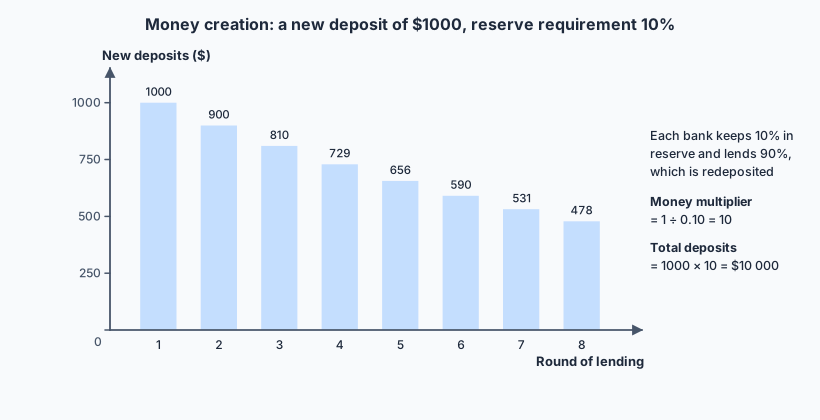
In practice, the multiplier is smaller: banks hold extra reserves, people hold some cash, and in bad times banks lend less and firms borrow less.
The tools of monetary policy HL
- Open market operations: the central bank buys or sells government bonds. Buying bonds pays money into the banking system, raising reserves and the money supply, and lowering interest rates. Selling bonds does the opposite.
- Minimum reserve requirements: the share of deposits banks must hold as reserves. Lowering it lets banks lend more (a larger multiplier). Bank Indonesia has used changes to reserve requirements alongside its policy rate.
- The central bank’s minimum lending rate (base rate, discount rate, refinancing rate; in Indonesia the BI-Rate): the rate at which the central bank lends to commercial banks. Changes feed through to the rates banks charge on loans and pay on deposits. This is the main tool in normal times.
- Quantitative easing (QE): when interest rates are already near zero, the central bank creates new money to buy large amounts of government bonds and other assets, pushing down long-term interest rates and raising asset prices and bank lending. Used by the Fed, ECB, Bank of England and Bank of Japan after 2008 and during the pandemic. Risks: asset-price bubbles, inequality (asset owners gain), inflation later.
The money market and the equilibrium interest rate HL
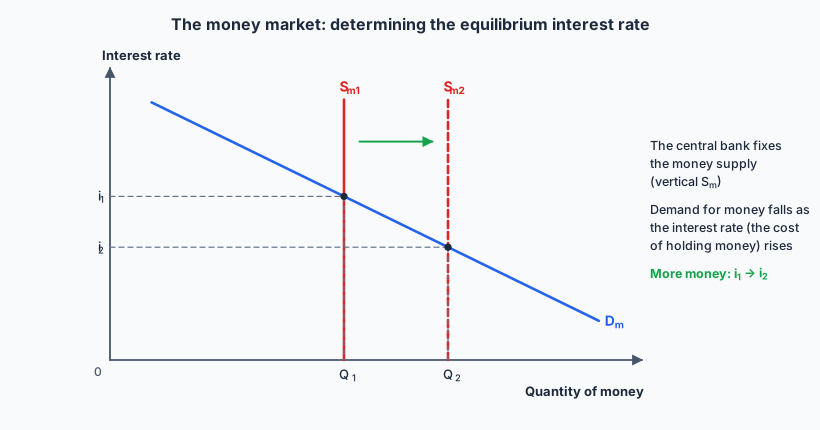
- The supply of money is fixed by the central bank, so it is vertical.
- The demand for money slopes down: the interest rate is the opportunity cost of holding money rather than interest-earning assets, so at higher rates people hold less money.
- An increase in the money supply (Sm1 to Sm2) lowers the equilibrium interest rate; a decrease raises it.
Real and nominal interest rates
The nominal interest rate is the rate stated by banks. The real interest rate adjusts for inflation and shows the true cost of borrowing and the true return to saving.
A negative real rate (inflation above the nominal rate) erodes savings and makes borrowing very cheap: a strong stimulus. Decisions to save and invest depend on real rates.
Expansionary and contractionary monetary policy
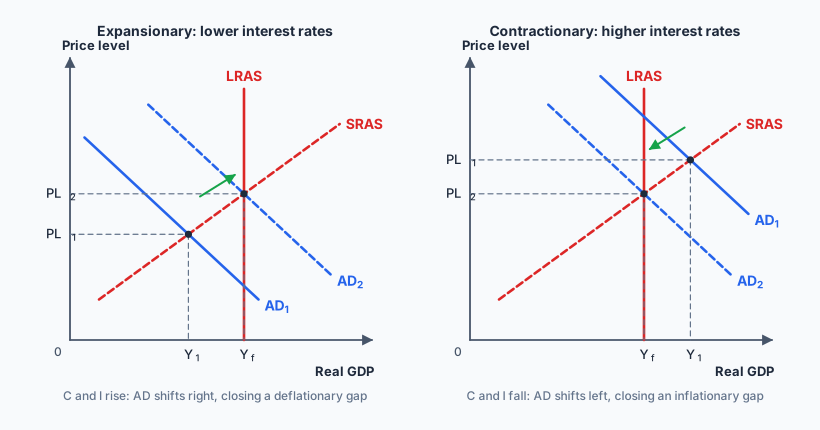
lower interest rates / more money. Borrowing becomes cheaper and saving less rewarding, so consumption (especially on credit) and investment rise; mortgage payments fall, raising disposable income; asset prices rise (wealth effect); the currency tends to depreciate, raising net exports. AD shifts right, closing a deflationary gap.
higher interest rates / less money. C, I and net exports fall; AD shifts left, closing an inflationary gap and reducing demand-pull inflation. Bank Indonesia raised the BI-Rate from 3.5% in mid-2022 to 6.25% by April 2024 to hold down inflation and support the rupiah.
How effective is monetary policy?
Constraints (weaknesses):
- Limited scope for cutting rates close to zero: once rates are near 0%, they cannot be cut much further (the “zero lower bound”), so central banks turn to QE. Japan’s long period of near-zero rates showed the limits.
- Low consumer and business confidence: in a deep recession, even very cheap credit may not persuade pessimistic firms to invest or households to borrow (“pushing on a string”). Banks may also refuse to lend.
- Time lags: changes take many months (often 12–24) to have their full effect.
- Cost-push inflation: raising rates to fight supply-driven inflation reduces output further.
- Side effects: high rates hurt borrowers, the housing market and investment; rate differences with other countries move the exchange rate.
- Transmission is weaker where many people have no bank account or loans (financial inclusion matters).
Strengths:
- Independence of the central bank from political pressure gives credibility.
- Incremental, flexible and easily reversible: rates can change by 0.25 percentage points at a monthly meeting, and be reversed.
- Short time lags in the decision: no parliamentary approval needed, unlike fiscal policy.
- No direct effect on the government budget; no crowding out.
- Very effective against demand-pull inflation: the rapid tightening of 2022–23 brought inflation down in most economies.
Overall: monetary policy is generally stronger for reducing inflation than for pulling an economy out of a deep recession (where fiscal policy may be needed), and it cannot affect long-run growth except by providing stability.
✏️Worked example
(b) A year later the nominal rate is 3.0% and inflation 4.2%. Calculate the real rate and explain what has happened to savers.
(c) HL The reserve requirement is 10%. A new deposit of $1000 is made. Calculate the maximum increase in total deposits, and explain what happens if the requirement is cut to 8%.
(a) 4.5 − 2.8 = 1.7%.
(b) 3.0 − 4.2 = −1.2%. The real rate is negative: the purchasing power of savings falls even though the money balance grows. Savers lose; borrowers gain. It encourages spending rather than saving.
(c) Multiplier = 1 ÷ 0.10 = 10, so total deposits can rise to $10 000 (of which $9000 is new lending). At 8%, the multiplier is 1 ÷ 0.08 = 12.5, allowing deposits of $12 500: the money supply can expand further, which is expansionary.
📝Practise
Tagged questions are modelled on a real IB question from that session, with our own wording and context.
1. [2 marks, Paper 2 style] Define the term inflation targeting.
2. [10 marks, Paper 1 (a) — modelled on May 2024 HL Paper 1 Q2(a)] Explain how a cut in the central bank’s policy rate works through consumption, investment and net exports to change real GDP.
3. [15 marks, Paper 1 (b) — modelled on May 2023 HL Paper 1 Q2(b)] Using real-world examples, examine why cutting interest rates may fail to end a deep recession.
How it works: expansionary monetary policy, AD/AS diagram, transmission to C, I, X.
Limitations in a deep recession: zero lower bound (rates already near zero in 2008–09 and 2020); low confidence and weak bank lending (“pushing on a string”); time lags; debt-laden households cannot borrow more; QE raised asset prices more than spending. Japan’s experience.
Strengths: quick decisions, flexible, independent, no budget cost; aggressive cuts plus QE did support recovery in the US after 2009.
Judgment: monetary policy alone is often insufficient for a large gap; it works best combined with fiscal stimulus, as in 2020.
4. [15 marks, Paper 1 (b) — modelled on May 2024 SL Paper 1 Q2(b)] Using real-world examples, evaluate the use of higher interest rates to bring inflation back to its target.
Effective against demand-pull: higher rates reduce C and I, shift AD left (diagram). The 2022–24 tightening by the Fed, ECB and Bank Indonesia was followed by falling inflation. Credible inflation targets anchor expectations.
Less effective / costly against cost-push: an oil or food price shock shifts SRAS; raising rates reduces output and jobs further (stagflation dilemma). Time lags risk over-tightening; high rates hurt borrowers, housing and investment; capital inflows appreciate the currency (which helps inflation but hurts exporters).
Judgment: effective for demand-driven inflation with a credible, independent central bank; needs support from supply-side and fiscal measures when inflation comes from supply shocks.
5. HL Explain how quantitative easing is intended to increase aggregate demand.
6. [4 marks, Paper 2 style] Using an AD/AS diagram, explain the likely effect on an economy of higher interest rates set to reduce inflation.
🔗Go deeper — other people’s work
These are external resources, not mine. If one stops working, tell me and everything above it on this page still stands.
- Bank Indonesia — Board of Governors meeting statements explaining each BI-Rate decision.
- Bank of England — Money creation in the modern economy (Quarterly Bulletin, 2014), a clear explainer.
- Federal Reserve Education — how the Fed sets interest rates.