Critique of the maximizing behaviour of consumers and producers
🎯What you need to be able to do
- HL Explain the assumptions of rational consumer choice: consumer rationality, utility maximization and perfect information.
- HL Explain the limitations of these assumptions: biases (rule of thumb, anchoring and framing, availability), bounded rationality, bounded self-control, bounded selfishness and imperfect information.
- HL Explain choice architecture (default, restricted and mandated choices) and nudge theory, and evaluate their use.
- HL Explain profit maximization and alternative business objectives: corporate social responsibility, market share, satisficing and growth.
📚The economics
Rational consumer choice
Traditional (neoclassical) theory models consumers as rational decision-makers. It assumes:
- Consumer rationality: consumers have clear, consistent preferences and weigh costs and benefits carefully, choosing the option that is best for them.
- Utility maximization: with limited income, they allocate spending so as to get the greatest possible total satisfaction.
- Perfect information: they know all the prices, qualities and alternatives available.
These assumptions make models simple and predictions clear: for instance, the law of demand follows from utility maximization and diminishing marginal utility (2.1). Behavioural economics asks how realistic they are.
Behavioural economics: the limits of rationality
Biases are systematic errors in judgment.
- Rule of thumb (heuristics): mental shortcuts that save time but can mislead. “Always buy the brand my parents bought”, “choose the middle-priced wine”.
- Anchoring: relying too heavily on the first number seen. A jacket “reduced from Rp 1,200,000 to Rp 600,000” seems a bargain because of the anchor, even if Rp 600,000 is above what it is worth to you.
- Framing: the way information is presented changes the choice. Yoghurt labelled “90% fat free” sells better than “contains 10% fat”, though they mean the same thing.
- Availability: judging how likely something is by how easily examples come to mind. After news of a plane crash, people overestimate the risk of flying and may drive instead, which is statistically more dangerous.
Three kinds of boundedness describe the limits on how rational anyone can be:
- Bounded rationality: people are rational only within limits of information, time and brainpower, so they choose options that are “good enough” rather than the best. Nobody compares every mobile data plan on the market.
- Bounded self-control: people make choices they know are against their long-term interest: overeating, smoking, not saving for retirement, spending on buy-now-pay-later apps. They value the present too heavily.
- Bounded selfishness: people are not purely self-interested. They donate to charity, volunteer, tip, return lost wallets and pay more for fair-trade products. In Bali, gotong royong (mutual help) and banjar community obligations are everyday examples.
- Imperfect information: consumers often lack information about quality, risks or alternatives (see asymmetric information, 2.10).
Behavioural economics in action: choice architecture and nudges
Choice architecture is the design of the way choices are presented. Because behaviour depends on presentation, governments and firms can influence decisions by designing the choice, without banning anything or changing prices.
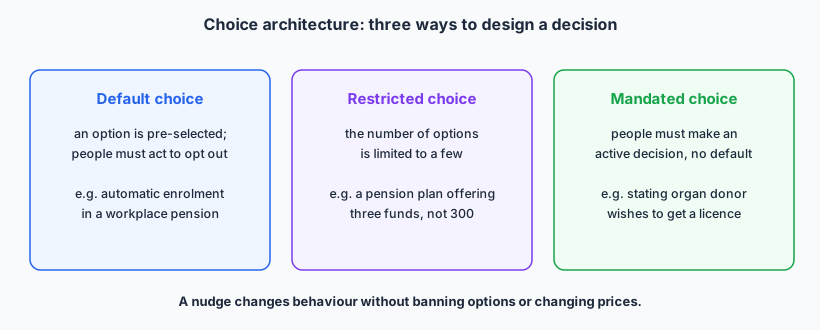
- Default choice: because people tend to stick with whatever is pre-selected, the default matters enormously. The UK’s automatic enrolment in workplace pensions (from 2012) sharply raised the share of employees saving for retirement. Countries with opt-out organ donation systems tend to have higher registration rates than opt-in countries.
- Restricted choice: too many options overwhelm people (choice overload), so limiting options can improve decisions.
- Mandated choice: people are required to decide actively, which avoids both inertia and the charge that the government chose for them.
Nudge theory (Thaler and Sunstein) holds that small, cheap changes to the choice environment can steer behaviour in a desired direction while leaving people free to choose otherwise. Examples: placing fruit at eye level in school canteens; graphic warnings on cigarette packs; text-message reminders to pay taxes on time; showing households how their electricity use compares with their neighbours’; painted lines and flies in urinals.
Cheap to introduce; preserve freedom of choice; politically easier than taxes or bans; can be tested with trials; target the behavioural cause of the problem directly.
Effects can be small or fade over time; may be seen as manipulative (who decides what is “good”?); firms use the same techniques to push consumers the other way; do not work for strong addictions; not enough alone for large problems such as climate change.
Business objectives
Profit maximization is the standard assumption: firms produce where profit (TR − TC) is greatest, which is where marginal revenue equals marginal cost (MR = MC) (2.11). Firms may pursue other objectives:
- Corporate social responsibility (CSR): acting ethically towards workers, communities and the environment beyond what the law requires: fair wages in supply chains, reducing emissions, community projects. CSR may reduce short-run profit, but it can build brand loyalty, attract staff and investors, and head off regulation. Critics point to “greenwashing”: CSR as marketing rather than substance.
- Market share: the firm’s sales as a percentage of total market sales. Firms may cut prices to win share, accepting lower profits now in return for market power later. Ride-hailing and e-commerce platforms in Southeast Asia spent years subsidizing rides and deliveries to capture users.
- Satisficing: aiming for a satisfactory level of profit rather than the maximum. Common in large firms where owners (shareholders) and managers are different people: managers may prefer a quiet life, prestige or balancing stakeholder demands, provided profit is enough to keep shareholders content. Links to bounded rationality: firms lack the information to find the true maximum.
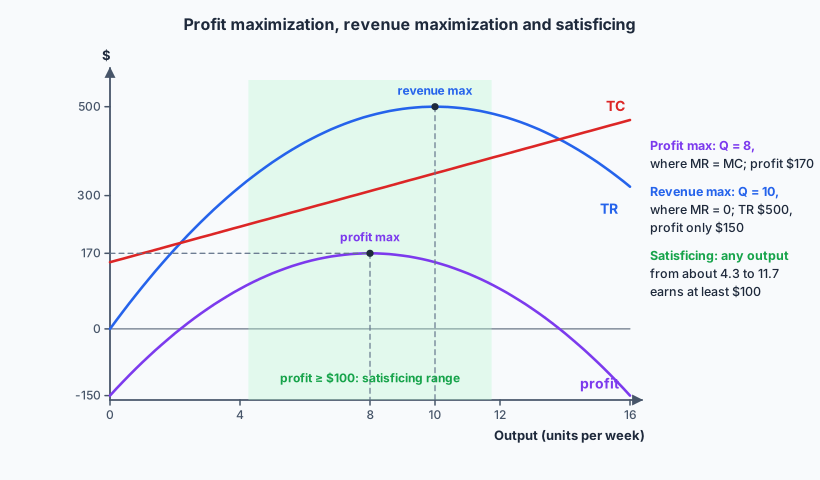
- Growth: maximizing size (sales revenue, output, number of outlets). Bigger firms gain economies of scale, security from takeover and managerial status. Revenue maximization is at the output where MR = 0.
✏️Worked example HL
(a) Calculate profit at Q = 8 and at Q = 10.
(b) Show that Q = 8 is profit-maximizing and Q = 10 is revenue-maximizing.
(c) The managers aim to earn at least $100 profit. Explain what range of output satisfies them, and why they might choose an output above 8.
(a) At Q = 8: TR = 800 − 320 = 480; TC = 150 + 160 = 310; profit = $170. At Q = 10: TR = 1000 − 500 = 500; TC = 150 + 200 = 350; profit = $150.
(b) Marginal revenue is the change in TR from one more unit, MR = 100 − 10Q; marginal cost is constant at MC = 20.
(c) Profit = TR − TC = 80Q − 5Q2 − 150. Setting this equal to 100 gives Q2 − 16Q + 50 = 0, so Q = 8 ± √14, about 4.3 to 11.7 units. Any output in this range satisfices. Managers might choose, say, 10 units: sales revenue and market share are larger, the firm looks bigger and more successful, and profit is still acceptable to shareholders at $150.
📝Practise
All HL. Tagged questions are modelled on a real IB question from that session, with our own wording and context.
1. [2 marks, Paper 2 style] Define the term nudge.
2. Explain the difference between anchoring and framing, with an example of each.
3. [15 marks, Paper 1 (b) — modelled on May 2023 HL Paper 1 Q1(b)] Using real-world examples, examine how far behavioural economics undermines the model of the rational, utility-maximizing consumer.
Structure: define rational consumer choice and its three assumptions. Explain why economists use them (simple, predictive models; they explain the law of demand).
Against: biases with examples (anchoring in “sale” pricing; availability and fear of flying); bounded rationality (people do not compare hundreds of phone plans); bounded self-control (smoking rates, under-saving, the success of pension auto-enrolment shows inertia rather than calculation); bounded selfishness (charitable giving, fair-trade premiums); imperfect information.
For: in many repeated, simple, high-stakes purchases people do respond to prices as the model predicts (petrol demand falls when prices rise; shoppers switch supermarkets for discounts). Firms and markets punish some errors.
Judgment: for example, the assumption is a useful simplification for predicting responses to price changes, but a poor description of choices involving the future, risk and complex products, which is why nudges and regulation can improve outcomes. Top-band answers support each point with a specific example and reach a reasoned conclusion.
4. Evaluate the use of nudges to reduce sugar consumption among teenagers.
5. [15 marks, Paper 1 (b) — modelled on May 2024 HL Paper 1 Q1(b)] Using real-world examples, discuss whether profit maximization is a realistic description of how large firms behave.
For the view: shareholders own firms and demand returns; competitive pressure forces firms to cover costs; managers’ pay is often linked to profit; a firm that ignores profit may be taken over. The MR = MC rule is the standard model.
Against: separation of ownership and control leads to satisficing; firms chase market share or growth (platforms that ran losses for years to build users); CSR choices that raise costs (renewable energy, living-wage commitments); social enterprises and co-operatives have non-profit goals; firms lack the information to find the exact MR = MC point (bounded rationality).
Evaluation: many alternative objectives are really long-run profit maximization (market share now for pricing power later; CSR to protect the brand). Short run versus long run, the type of firm (listed corporation versus family business versus social enterprise), and the market structure all affect the answer. Draw the TR/TC/profit diagram or the MR = MC diagram to show the difference between objectives.
6. Explain why a firm pursuing growth might produce more than the profit-maximizing output.
🔗Go deeper — other people’s work
These are external resources, not mine. If one stops working, tell me and everything above it on this page still stands.
- Richard Thaler and Cass Sunstein, Nudge — the book that popularized choice architecture.
- Daniel Kahneman, Thinking, Fast and Slow — heuristics and biases from the source.
- The Behavioural Insights Team — published trial results of real government nudges.