Market failure: asymmetric information
🎯What you need to be able to do
- HL Explain asymmetric information as a market failure.
- HL Explain adverse selection and moral hazard, with examples.
- HL Evaluate government responses (legislation and regulation, provision of information) and private responses (signalling and screening).
📚The economics
Asymmetric information
Asymmetric information exists when one party to a transaction has more or better information than the other. Usually the seller knows more (about product quality), but sometimes the buyer does (a person buying health insurance knows more about their own health than the insurer). Because the less-informed side cannot judge quality or risk, it cannot value the transaction correctly, so the market allocates resources inefficiently: a market failure.
Adverse selection
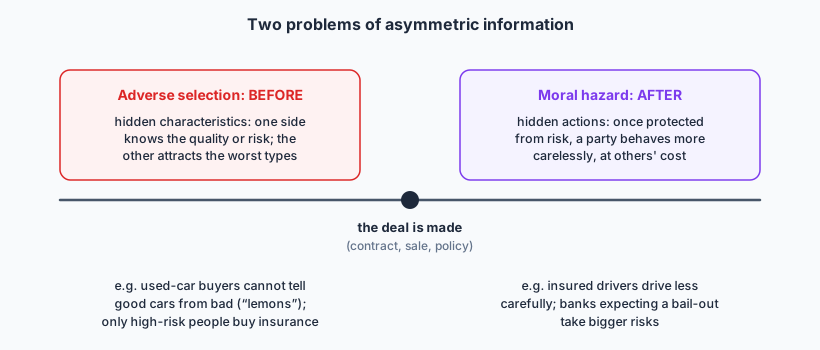
Adverse selection arises before a transaction, when one party has hidden information about the quality of what is traded, so the less-informed side ends up attracting the “wrong” (worst) customers or products.
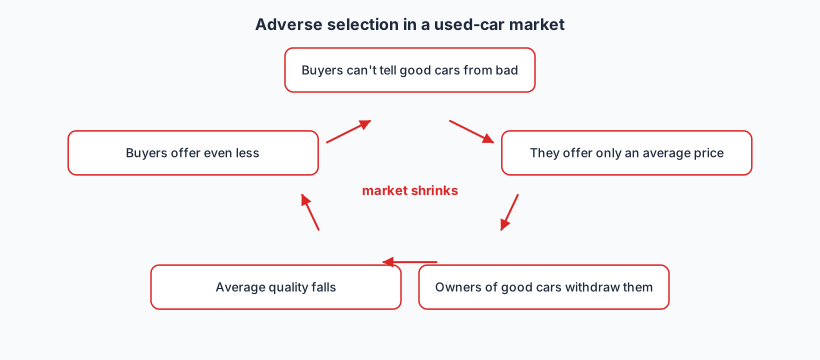
- The market for “lemons” (George Akerlof, 1970): sellers of used cars know whether their car is good or bad; buyers do not, so they will only pay a price reflecting average quality. Owners of good cars find this too low and withdraw them. Average quality falls, buyers offer even less, and more good cars leave. The market shrinks, and good cars may not be traded at all, even though buyers would pay their full value if they could recognize them.
- Insurance: people at high risk are the most eager to buy health or travel insurance. If the insurer cannot tell who is high-risk, it must charge a premium based on average risk, which low-risk people find too expensive; they drop out, the pool gets riskier, premiums rise further.
- Credit: borrowers willing to pay very high interest rates may be those least likely to repay.
Moral hazard
Moral hazard arises after a transaction, when one party changes its behaviour in a way the other cannot observe, taking more risks because it no longer bears the full cost of them.
- Insurance: once a phone or car is insured, the owner may take less care; once health costs are fully covered, patients and doctors may over-use services.
- Banking: banks that expect a government bail-out if they fail (“too big to fail”) may lend too riskily, as many did before the 2008 global financial crisis. The profits are private; the losses fall on taxpayers.
- Employment: a worker on a fixed salary who is not monitored may put in less effort (the principal–agent problem).
Government responses
Consumer protection laws (the right to a refund for faulty goods); licensing of doctors, lawyers and financial advisers; food safety standards and inspection (Indonesia’s BPOM approves food and medicines); mandatory disclosure of loan terms; compulsory insurance for everyone (removes adverse selection by keeping low-risk people in the pool); bank capital requirements to curb moral hazard.
Compulsory labelling (nutrition, energy ratings, cigarette health warnings, halal certification); public databases of hospital or school performance; financial literacy programmes. These reduce the information gap directly.
Evaluation: regulation can be costly to enforce, may be captured by the industry it regulates, and can raise costs and prices; information only helps if consumers read and understand it (bounded rationality, 2.4). Compulsory insurance restricts freedom and needs subsidies for those who cannot afford it.
Private responses
The informed party takes a costly, visible action to reveal quality: warranties and guarantees, brand names and reputation, certified pre-owned cars, online reviews and seller ratings on e-commerce platforms, and educational qualifications (a degree signals ability to employers).
The uninformed party takes action to uncover information: insurers requiring medical checks and charging different premiums, excess charges (deductibles) and no-claims discounts; banks checking credit scores and asking for collateral; employers testing and interviewing candidates; buyers paying for an independent vehicle inspection.
Private responses often work well where reputation matters and transactions repeat, but they add costs, and some signals are unreliable (fake reviews, degree inflation).
✏️Worked example HL
(a) Calculate the most a buyer will pay for a bike of unknown quality.
(b) Explain what happens in the market.
(c) Explain how a certified inspection scheme changes the outcome.
(a) Expected value to a buyer = 0.5 × 12 + 0.5 × 6 = Rp 9 million.
(b) Rp 9 million is below the Rp 10 million minimum for good-bike owners, so they withdraw. Buyers realise that only poor bikes remain, so they will pay at most Rp 6 million. Only poor bikes are traded: the good bikes, which buyers value at Rp 12 million and owners at Rp 10 million, are not sold at all, and the potential gain of up to Rp 2 million on each is lost. This is adverse selection.
(c) Certification lets sellers signal quality credibly. Good bikes can then sell at a price between Rp 10 and 12 million, and poor ones between Rp 5 and 6 million. Both types are traded, and the surplus is recovered, minus the cost of inspection.
📝Practise
All HL. Tagged questions are modelled on a real IB question from that session, with our own wording and context.
1. [2 marks, Paper 2 style] Define the term moral hazard.
2. Explain how a no-claims discount on car insurance reduces moral hazard.
3. Distinguish between signalling and screening, with an example of each from the labour market.
4. [15 marks, Paper 1 (b) — modelled on November 2022 HL Paper 1 Q1(b)] Using real-world examples, evaluate whether government regulation or private signalling and screening is the better response to asymmetric information in the market for used cars.
Explain asymmetric information and why it causes market failure (adverse selection or moral hazard, with a named market: health insurance, used cars, financial products, medicines).
Policies: (1) legislation and regulation: licensing, consumer protection, bank capital rules, compulsory insurance; (2) provision of information: labelling, quality ratings, disclosure. Give real examples (food and drug agencies; nutrition labels; deposit insurance with regulation after 2008).
Evaluate each: costs of enforcement, regulatory capture, higher costs passed to consumers, bounded rationality limits information campaigns, compulsory insurance raises equity questions. Compare with private solutions (warranties, reviews, screening), which may make government action unnecessary in some markets.
Judgment: for example, government regulation is essential where the consequences of poor information are severe and hard to reverse (medicines, banking), while in markets with repeat purchases and reputations, private responses do much of the work.
5. Explain why a universal, compulsory national health insurance scheme can overcome adverse selection.
6. Explain how the expectation of government bail-outs can create moral hazard in banking.
🔗Go deeper — other people’s work
These are external resources, not mine. If one stops working, tell me and everything above it on this page still stands.
- George Akerlof, The Market for “Lemons” (1970), and the 2001 Nobel prize popular summary on information economics.
- Khan Academy and Marginal Revolution University — short videos on adverse selection and moral hazard.
- Bank for International Settlements — accessible explainers on the Basel capital rules introduced after 2008.