Balance of payments
🎯What you need to be able to do
- Explain credit and debit items and surpluses and deficits; describe the current account (trade in goods and services, primary income, secondary income), the capital account and the financial account (FDI, portfolio investment, reserve assets, official borrowing).
- Explain the interdependence of the accounts: the zero balance, credits matched by debits, deficits by surpluses.
- Calculate elements of the balance of payments from data.
- HL Explain the relationship between the current account, the financial account and the exchange rate (with a diagram).
- HL Explain the implications of a persistent current account deficit and surplus; methods of correcting a deficit (expenditure switching, expenditure reducing, supply-side policies) and their effectiveness; the Marshall–Lerner condition and the J-curve.
📚The economics
Credits and debits
any transaction that brings money into the country: exports, income earned abroad, inflows of investment, borrowing from abroad.
any transaction that sends money out: imports, income paid to foreigners, investment abroad, repaying foreign loans.
An account is in surplus when its credits exceed its debits, and in deficit when debits exceed credits.
The three accounts
1. The current account records trade and income flows:
- Balance of trade in goods (visible trade): exports minus imports of goods. Indonesia usually has a surplus, thanks to coal, palm oil and nickel products.
- Balance of trade in services (invisible trade): tourism, transport, insurance, finance, education, IT services. Indonesia typically runs a deficit (freight, insurance, royalties), partly offset by tourist spending in Bali.
- Primary income (“income”): wages, interest, profits and dividends earned from abroad minus those paid abroad. Indonesia runs a large deficit because foreign investors repatriate profits and interest.
- Secondary income (“current transfers”): transfers with nothing given in return: remittances from migrant workers, foreign aid, gifts. A surplus for Indonesia because of workers abroad.
2. The capital account is small: capital transfers (debt forgiveness, migrants’ transfers of assets) and transactions in non-produced, non-financial assets (patents, copyrights, trademarks, and land sold to embassies).
3. The financial account records flows of investment and changes in assets:
- Foreign direct investment (FDI): investment to set up or acquire a lasting controlling interest (typically 10% or more) in a firm: a new factory, a takeover. Inward FDI is a credit; outward FDI a debit.
- Portfolio investment: purchases of shares and bonds without control. Mobile and volatile (“hot money”).
- Reserve assets: the central bank’s holdings of foreign currency and gold. Using reserves to finance a deficit appears as a credit; building them up as a debit.
- Official borrowing: loans between governments and international institutions (IMF, World Bank).
Why the balance of payments balances
Every transaction has two sides. If a country imports more than it exports (a current account deficit), it must pay for the difference by selling assets to foreigners, borrowing abroad or running down reserves: a financial account surplus. So credits are matched by debits, and a deficit on one account is matched by surpluses on the others. In practice, data are imperfect, and errors and omissions make the total exactly zero.
✏️Worked example
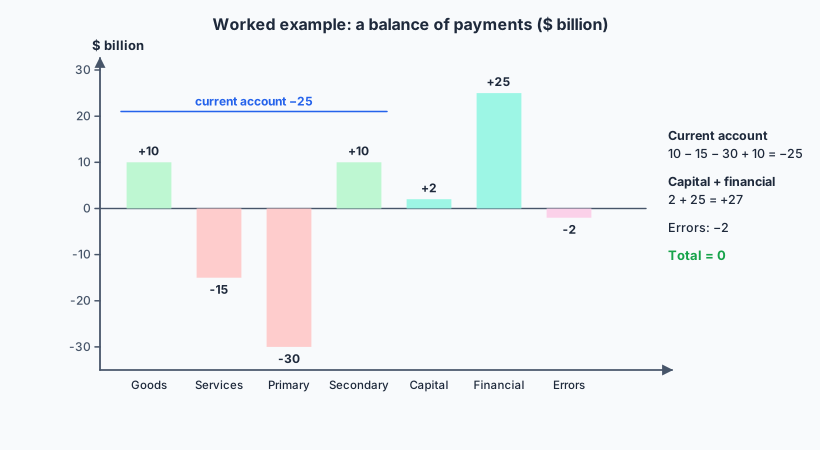
(a) Calculate the balance of trade in goods and services, and the current account balance.
(b) Calculate the financial account balance.
(a) Goods: 180 − 170 = +10. Services: 45 − 60 = −15. Balance of trade in goods and services = −5. Current account = 10 − 15 − 30 + 10 = −25.
(b) Current + capital + financial + errors = 0, so financial = 0 − (−25) − 2 − (−2) = +25. The current account deficit is financed by net inflows of investment and borrowing.
The current account, the financial account and the exchange rate HL
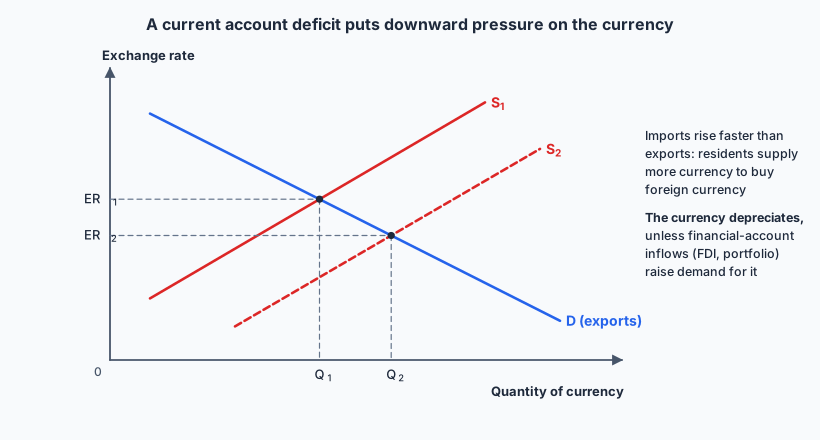
- Current account and exchange rate: a deficit means the country supplies more of its currency (to buy imports) than foreigners demand (to buy exports), so in a floating system the currency tends to depreciate, which in turn makes exports cheaper and helps correct the deficit. A surplus tends to cause appreciation.
- Financial account and exchange rate: financial inflows (FDI, portfolio investment attracted by high interest rates) raise demand for the currency and cause appreciation, which can widen a current account deficit. Large inflows can keep a deficit country’s currency strong until sentiment turns, when outflows cause sharp depreciation (the 1997–98 Asian crisis; the 2013 “taper tantrum”, when the rupiah fell sharply).
Persistent current account deficits HL
A deficit is not always a problem: a fast-growing country importing capital goods, financed by long-term FDI, may be investing in future growth. A persistent deficit, especially one financed by short-term borrowing, has implications for:
- Exchange rates: downward pressure on the currency, making imports and foreign debt dearer.
- Interest rates: the central bank may raise rates to attract financial inflows and support the currency, slowing domestic growth.
- Foreign ownership of domestic assets: the deficit is financed by selling assets (firms, land, bonds) to foreigners, so future profits and interest flow abroad, widening the primary income deficit.
- Debt: borrowing from abroad accumulates foreign debt and interest costs.
- Credit ratings: may be downgraded, raising borrowing costs.
- Demand management: governments may have to cut spending or raise rates to reduce imports, sacrificing growth and jobs.
- Economic growth: the deficit means spending leaks abroad (imports are a leakage), and adjustment may require a slowdown.
Correcting a persistent deficit HL
- Expenditure-switching policies: switch spending from imports to domestic goods: depreciation or devaluation (exports cheaper, imports dearer) and protection (tariffs, quotas). Risks: inflation, retaliation, WTO rules.
- Expenditure-reducing policies: reduce total spending, including on imports, through contractionary fiscal and monetary policy. Effective but costly: lower growth and higher unemployment. Also lowers inflation, improving competitiveness.
- Supply-side policies: raise productivity, quality and competitiveness of domestic firms (education, infrastructure, R&D, deregulation). The best long-run solution, but slow.
The Marshall–Lerner condition and the J-curve HL
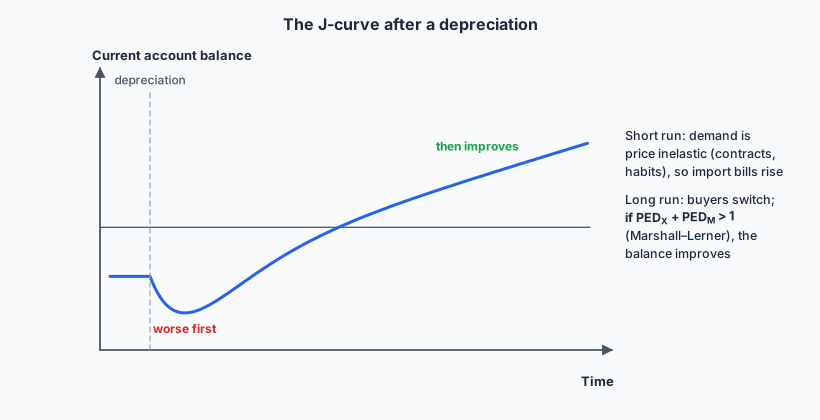
A depreciation improves the current account only if the volume changes (more exports, fewer imports) are large enough to outweigh the price changes (each import now costs more in domestic currency).
- Marshall–Lerner condition: a depreciation improves the current account if the sum of the price elasticities of demand for exports and imports is greater than one: |PEDX| + |PEDM| > 1.
- The J-curve: in the short run, demand for imports and exports is price inelastic (existing contracts, habits, time to find new suppliers), so the condition does not hold and the deficit worsens. Over time, elasticities rise, the condition is met, and the balance improves: the path traces a J.
Persistent current account surpluses HL
- Domestic consumption and investment: resources are devoted to producing goods for foreigners rather than for domestic households; lower living standards than possible.
- Exchange rates: upward pressure on the currency, which may harm export competitiveness later.
- Inflation: strong export demand raises AD, and inflows of foreign currency can expand the money supply.
- Employment: supports jobs in export industries, but reliance on exports is a risk if world demand falls.
- Export competitiveness and international tension: surplus countries (China, Germany) are accused of contributing to others’ deficits and may face protectionism.
📝Practise
Tagged questions are modelled on a real IB question from that session, with our own wording, numbers and context.
1. [2 marks, Paper 2 style] Define the term current account.
2. [2 marks, Paper 2 style] Exports of goods are $64 bn, imports of goods $71 bn, exports of services $18 bn, imports of services $15 bn. Calculate the balance of trade in goods and services.
3. HL [Paper 3 style] A country’s current account is −$12 bn, its capital account +$1 bn and net errors and omissions +$0.5 bn. Calculate the financial account and explain what it shows about foreign ownership of assets.
4. HL Explain the Marshall–Lerner condition and why a depreciation may initially worsen a current account deficit.
5. HL Evaluate expenditure-reducing policies as a way to correct a persistent current account deficit.
6. [15 marks, Paper 2 (g) style] Using information from a text and your knowledge of economics, discuss the implications for a country of a persistent current account deficit.
🔗Go deeper — other people’s work
These are external resources, not mine. If one stops working, tell me and everything above it on this page still stands.
- Bank Indonesia — Indonesia’s Balance of Payments Report, quarterly.
- IMF — External Sector Report, on global imbalances.
- Trading Economics — quick charts of current account balances by country.