Market failure: public goods
🎯What you need to be able to do
- Explain the characteristics of public goods: non-rivalrous and non-excludable.
- Distinguish public goods from private goods, common pool resources and club goods.
- Explain the free rider problem and why it leads to market failure.
- Evaluate government responses: direct provision and contracting out to the private sector.
📚The economics
Rivalry and excludability
one person’s consumption reduces the amount available to others. If I eat a mango, you cannot.
one person’s consumption does not reduce what is available to others. My use of a street light leaves just as much light for you.
it is possible to prevent people who have not paid from consuming it (a ticket barrier, a password, a fence).
it is impossible, or too costly, to stop non-payers from benefiting. You cannot stop one house on a street from being protected by a sea wall.
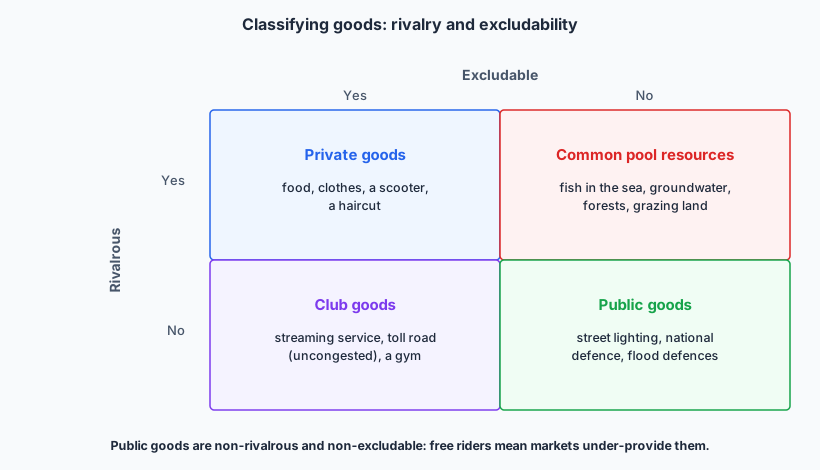
A pure public good is both non-rivalrous and non-excludable. Examples: national defence, street lighting, lighthouses, flood defences and sea walls, public fireworks displays, disease surveillance, basic research findings, and tsunami early-warning systems such as the buoys and sirens along Indonesian coasts.
Many goods are quasi-public: a road is non-rivalrous when empty but rivalrous in a traffic jam, and can be made excludable with tolls. A beach is non-excludable and mostly non-rivalrous until it gets crowded.
The free rider problem
Because a public good is non-excludable, people can enjoy it without paying: they free ride on those who do pay. Each person reasons that the good will be provided whether or not they contribute, so they keep their money. Since firms cannot charge users, they cannot earn revenue, and so the private market does not produce the good at all, or produces far too little: a missing market.
This is a market failure: the social benefit of a flood wall may far exceed its cost, yet no firm will build it. Resources are underallocated, and there is a welfare loss equal to the whole surplus that the good would have created.
Government responses
The government produces the good itself and pays for it from taxation, which solves free riding because everyone is compelled to contribute. Armed forces, street lighting run by local government, national disaster agencies.
The government pays private firms to produce the good, while still funding it from taxes. A construction company builds the sea wall under a public contract; a private firm maintains street lights. Public–private partnerships (PPPs) are a variant used widely for Indonesian toll roads and infrastructure.
- Strengths of direct provision: guarantees the good exists; can prioritize equity and access; accountable to voters.
- Limitations: the government must estimate how much people value the good, which is hard when nobody pays (people understate their value if asked to pay, overstate it if not); opportunity cost of tax revenue; possible inefficiency without competition; corruption risk in large projects.
- Strengths of contracting out: competition for contracts can cut costs and bring private expertise and innovation; the government keeps control of what is provided.
- Limitations: firms may cut quality to raise profit; writing and monitoring contracts is costly; risk of collusion or corruption in tendering; the public still pays.
Other solutions sometimes work for particular goods: technology can make a good excludable (encrypted TV signals, toll roads); voluntary or charitable provision (lifeboat services funded by donations); and community provision, as in Balinese banjar-organized local security and village infrastructure.
✏️Worked example
(a) Public good. Everyone in range hears the siren whether they paid or not (non-excludable), and one person hearing it does not stop anyone else (non-rivalrous). No firm could charge for it, so the state provides it.
(b) Club good. Non-paying users are locked out (excludable), but one subscriber streaming a song does not reduce what others can stream (non-rivalrous).
(c) Common pool resource. Anyone can fish in international waters (non-excludable), but each fish caught is one fewer for others (rivalrous).
(d) At 3 a.m. the toll road is a club good: excludable by the toll, non-rivalrous as it is empty. At 8 a.m. it becomes congested, so it is rivalrous and behaves like a private good.
📝Practise
Tagged questions are modelled on a real IB question from that session, with our own wording and context.
1. [2 marks, Paper 2 style] Define the term free rider problem.
2. Explain why a lighthouse is often given as an example of a public good.
3. Explain why the market for flood defences is described as a “missing market”.
4. [15 marks, Paper 1 (b) — modelled on May 2023 SL Paper 1 Q1(b)] Using real-world examples, evaluate whether governments should build and run public goods themselves or pay private firms to supply them.
For direct provision: free riding means markets fail; taxation solves it; equity and universal access; security-related goods (defence) should stay under state control.
Against / alternatives: contracting out and PPPs can be cheaper and more innovative (private firms building and maintaining infrastructure); technology can create excludability (tolls, pay-walls); charities and communities provide some public goods; government failure (inefficiency, corruption, poor information about valuation).
Judgment: the government should usually fund public goods, but need not produce them; the best choice depends on the good (defence versus street-light maintenance), the quality of institutions, and whether contracts can be monitored. Use at least two developed examples.
5. [15 marks, Paper 1 (b) — modelled on November 2022 SL Paper 1 Q1(b)] Using real-world examples, discuss the case for and against government funding of a national tsunami early-warning system.
6. Explain why the government might find it difficult to decide how much of a public good to provide.
🔗Go deeper — other people’s work
These are external resources, not mine. If one stops working, tell me and everything above it on this page still stands.
- Ronald Coase, The Lighthouse in Economics (1974) — a famous challenge to the textbook lighthouse example.
- Marginal Revolution University — Public goods and The tragedy of the commons videos.
- Indonesia’s Meteorology, Climatology and Geophysical Agency (BMKG) — how the tsunami early-warning system works.