Supply-side policies
🎯What you need to be able to do
- Explain the goals of supply-side policies: long-term growth, competition and efficiency, labour-market flexibility, lower inflation and better international competitiveness, and incentives to innovate.
- Explain market-based policies (deregulation, privatization, trade liberalization, anti-monopoly regulation; labour-market reforms; tax incentives) and interventionist policies (education and training, healthcare, R&D, infrastructure, industrial policies).
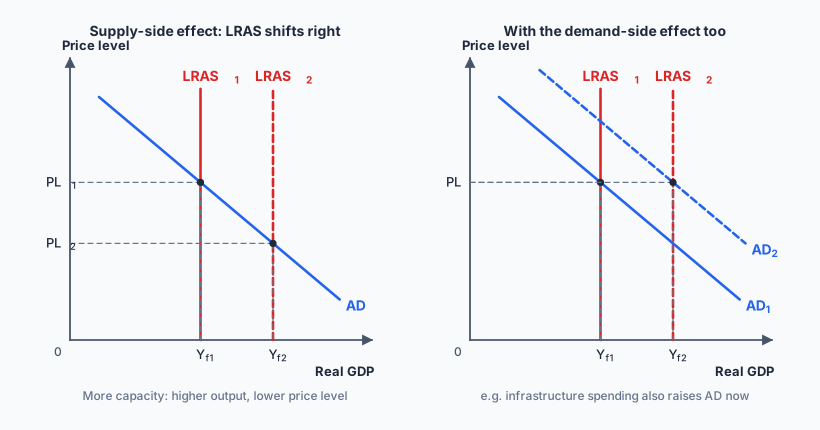
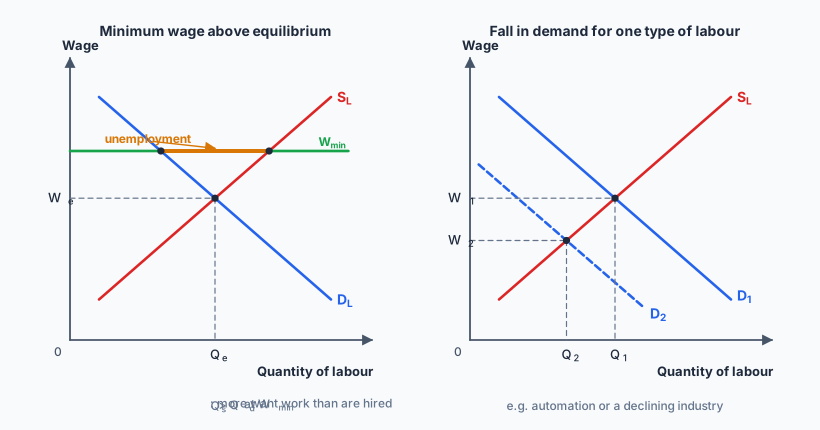
- Draw AD/AS and LRAS diagrams to show their effects; draw a minimum wage diagram.
- Explain the demand-side effects of supply-side policies and the supply-side effects of fiscal policies.
- Evaluate supply-side policies: constraints and strengths of each type, in promoting growth, low unemployment and low inflation.
📚The economics
Goals of supply-side policies
- Long-term growth by increasing the economy’s productive capacity (LRAS shifts right; the PPC shifts out).
- Improving competition and efficiency in product markets.
- Reducing labour costs and unemployment through labour-market flexibility (lowering the natural rate).
- Reducing inflation to improve international competitiveness: more capacity reduces inflationary pressure at any level of AD.
- Increasing firms’ incentives to invest in innovation by reducing costs.
Market-based supply-side policies
These rely on markets and incentives, reducing the role of government.
Policies to encourage competition:
- Deregulation: removing rules that restrict entry or raise costs (licensing requirements, red tape). Airline deregulation brought low-cost carriers and cheaper flights in Southeast Asia. Indonesia’s 2020 Job Creation (Omnibus) Law simplified business licensing.
- Privatization: selling state-owned enterprises to the private sector, where the profit motive is expected to raise efficiency.
- Trade liberalization: cutting tariffs and quotas exposes domestic firms to foreign competition and cheaper inputs (4.3).
- Anti-monopoly regulation: competition law to break up or prevent abuse of market power (2.11).
Labour-market policies (aimed at flexibility and lower labour costs):
- Reducing the power of labour unions, so wages reflect market conditions.
- Reducing unemployment benefits, to strengthen incentives to search for and accept work.
- Abolishing (or lowering) minimum wages: a minimum wage above equilibrium creates unemployment by raising labour costs.
Incentive-related policies:
- Personal income tax cuts, to increase incentives to work, take extra hours or enter the labour force.
- Cuts in business tax and capital gains tax, to increase incentives to invest, start firms and innovate, and to attract foreign direct investment. Indonesia cut its corporate tax rate from 25% to 22% in 2020.
Interventionist supply-side policies
Here the government directly invests or steers the economy, on the view that markets under-provide these things (they are merit goods or public goods with positive externalities).
- Education and training: raises human capital and labour productivity; retraining reduces structural unemployment (Indonesia’s Kartu Prakerja pre-employment card funds short training courses).
- Improving the quality, quantity and access to healthcare: a healthier workforce is more productive and works longer.
- Research and development: funding for universities and research institutes, R&D tax credits; raises technology and productivity.
- Provision of infrastructure: roads, ports, railways, power, internet (Indonesia’s toll-road network, the Jakarta–Bandung high-speed railway). Cuts transport and communication costs, links markets.
- Industrial policies: targeted support for industries seen as strategic: subsidies, tax holidays, special economic zones, local-content rules. Indonesia’s ban on exporting raw nickel ore (from 2020) to force processing at home, building a smelter and battery industry, is a prominent example.
Demand-side effects of supply-side policies, and supply-side effects of fiscal policy
- Many supply-side policies also shift AD in the short run: government spending on infrastructure, education and health is part of G; tax cuts raise C and I. So AD rises first, and LRAS shifts only later, when the road is built or the students graduate.
- Conversely, fiscal policy has supply-side effects: capital spending adds to productive capacity; tax structures affect incentives to work and invest. A stimulus focused on infrastructure raises AD now and LRAS later.
How effective are supply-side policies?
Equity issues: weaker unions, lower benefits and no minimum wage hurt low-paid workers; tax cuts favour high earners. Time lags. Vested interests: incumbents, unions and bureaucrats resist change. Environmental impact: deregulation may weaken environmental protection. Privatized monopolies may simply raise prices.
Improved resource allocation through competition and price signals; no burden on the government budget (privatization even raises revenue); can attract investment and lower costs.
Costs: large spending with an opportunity cost, adding to deficits and debt; risk of waste and corruption; government may “pick losers”. Time lags: education and infrastructure take years to pay off.
Direct support of sectors important for growth; tackles market failures (under-provision of education, R&D, infrastructure); can improve equity (access to education and health); creates jobs while being implemented (demand-side effect).
Supply-side policies and the macro objectives: they are the only policies that can deliver growth and lower unemployment (the natural rate) and lower inflation at the same time, because a rightward LRAS shift raises output while easing price pressure. But they work slowly, and do nothing for cyclical unemployment in a recession, when demand management is needed.
✏️Worked example
(A) Interventionist. Supply side: raises the quality of labour and matches skills to vacancies, lowering structural unemployment; LRAS shifts right in the long run. Demand side: spending on teachers, buildings and equipment raises G now, shifting AD right. Limitation: expensive, and the benefits arrive only after years; courses may not match what employers need.
(B) Market-based (incentive-related). Supply side: higher after-tax profits increase incentives and funds to invest and innovate, and attract FDI; capital stock rises, LRAS shifts right. Demand side: higher investment (I) shifts AD right. Limitation: lower tax revenue (opportunity cost for public services); firms may pay higher dividends instead of investing; benefits mainly go to shareholders, raising equity concerns.
📝Practise
Tagged questions are modelled on a real IB question from that session, with our own wording and context.
1. [2 marks, Paper 2 style] Define the term deregulation.
2. [10 marks, Paper 1 (a) — modelled on May 2022 HL/SL Paper 1 Q2(a)] Explain how deregulation and investment in transport infrastructure could make a country’s firms more competitive at home and abroad.
3. [10 marks, Paper 1 (a) — modelled on November 2024 SL Paper 1 Q2(a)] Explain why a large school-building programme affects both aggregate demand and aggregate supply, but at different times.
4. [15 marks, Paper 1 (b) — modelled on May 2022 HL/SL Paper 1 Q2(b)] Using real-world examples, evaluate the use of government training programmes to reduce youth unemployment.
For: training and education reduce structural unemployment by matching skills to jobs; infrastructure creates jobs during construction and opens new markets; industrial policy creates jobs in new sectors (nickel processing in Sulawesi). Diagrams: LRAS shift; labour-market diagram.
Against: slow; costly with opportunity cost; ineffective against cyclical unemployment (needs demand-side policy); market-based alternatives (labour-market flexibility) may work faster though with equity costs.
Judgment: depends on the type of unemployment: interventionist policies suit structural unemployment in the long run; fiscal/monetary policy suits cyclical; a combination is usual.
5. [15 marks, Paper 1 (b) — modelled on May 2024 HL Paper 1 Q2(b)] Using real-world examples, examine whether supply-side policies can deliver growth with low inflation where demand-side policies cannot.
For: an LRAS shift raises output and lowers the price level simultaneously (diagram), and can lower the natural rate of unemployment; demand-side policies face trade-offs (Phillips curve).
Against: long time lags, costs, equity and environmental concerns (market-based), no help in a sudden recession or with cost-push shocks; outcomes uncertain.
Judgment: most effective in the long run for sustained non-inflationary growth, but must be complemented by demand management for short-run stabilization.
6. Evaluate the use of a ban on raw mineral exports as an industrial policy.
🔗Go deeper — other people’s work
These are external resources, not mine. If one stops working, tell me and everything above it on this page still stands.
- OECD Economic Surveys: Indonesia — regular reviews of structural reforms and productivity.
- World Bank Indonesia Economic Prospects — twice-yearly reports discussing reform priorities.
- Tutor2u economics — revision articles on supply-side policies and their evaluation.