Economic growth and development strategies
🎯What you need to be able to do
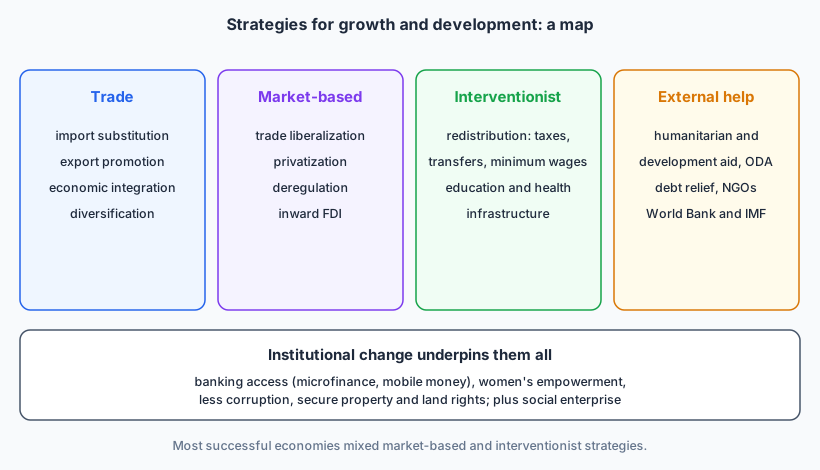
- Explain trade strategies (import substitution, export promotion, economic integration), diversification and social enterprise.
- Explain market-based policies (trade liberalization, privatization, deregulation) and interventionist policies (redistribution, merit goods: education, health, infrastructure).
- Explain the roles of inward FDI, foreign aid (humanitarian and development aid, debt relief, ODA, NGOs) and multilateral development assistance (the World Bank and IMF).
- Explain institutional change: access to banking (microfinance, mobile banking), women’s empowerment, reducing corruption, property and land rights.
- Evaluate these strategies, and government intervention versus market-oriented approaches; discuss progress on selected SDGs for two or more countries.
📚The economics
Trade strategies
protect domestic industries with tariffs and quotas so that locally made goods replace imports. Used widely in Latin America and in Indonesia in the 1960s–80s. For: builds industry, jobs, saves foreign exchange. Against: inefficient protected firms, small domestic markets limit economies of scale, higher prices, corruption in licences, anti-export bias.
orient production towards world markets: tax breaks and credit for exporters, export processing zones, competitive exchange rates, investment in infrastructure. The East Asian model (South Korea, Taiwan, later China and Vietnam). For: large markets, economies of scale, competition, foreign exchange, technology. Against: depends on world demand and open markets abroad; may mean low wages and weak labour/environmental standards; protectionism abroad.
- Economic integration: joining trade agreements and blocs (ASEAN, RCEP) for market access and investment (4.4).
- Diversification: reducing dependence on one or a few primary products by developing manufacturing, services and new exports: moving up the value chain (processing nickel into battery materials rather than exporting ore; developing tourism, digital and creative industries). Reduces vulnerability to price shocks.
- Social enterprise: businesses with a social or environmental mission that reinvest profits in that mission, combining market discipline with social goals (microfinance institutions, fair-trade cooperatives, clean-cookstove firms).
Market-based and interventionist policies
Trade liberalization (cutting tariffs and quotas), privatization of state enterprises and deregulation, often with fiscal discipline: the “Washington Consensus” policies of the 1980s–90s. Aim for efficiency, competition and investment (3.7). Risks: rising inequality, loss of infant industries, private monopolies, cuts to public services.
Redistribution through progressive taxes, transfer payments and minimum wages (3.4); provision of merit goods: education programmes, health programmes; infrastructure: energy, transport, telecommunications, clean water and sanitation. Aim to correct market failures and improve equity. Risks: cost, inefficiency, corruption, government failure.
Education and health programmes are among the most powerful strategies: they raise human capital (LRAS shifts right), reduce poverty and inequality of opportunity, and improve development directly (HDI). Conditional cash transfers such as Indonesia’s PKH combine income support with incentives for school attendance and health check-ups.
Foreign direct investment
capital and foreign exchange; jobs; transfer of technology, management and skills; access to global supply chains and export markets; tax revenue; infrastructure built alongside projects. FDI in electronics and car assembly helped transform Malaysia, Thailand and Vietnam.
profit repatriation (a primary income debit); tax avoidance through transfer pricing and generous incentives; few links to local firms (enclave production); crowding out of local businesses; environmental damage and weak labour standards; political influence; “footloose” firms may leave.
Foreign aid
- Humanitarian aid: emergency food, water, shelter and medical relief after disasters and conflict (the 2004 Aceh tsunami response). Short-term, saves lives.
- Development aid: longer-term support for health, education, infrastructure and institutions, as grants or concessional loans (below-market interest). Can be tied (must be spent on the donor’s goods and services), which reduces its value.
- Official development assistance (ODA): aid from governments (bilateral, such as Japan’s JICA or Australia’s DFAT) or via multilateral agencies, with a concessional element. The UN target for donors is 0.7% of GNI; few meet it.
- Debt relief: cancelling or rescheduling debts (the Heavily Indebted Poor Countries initiative), freeing revenue for health and education.
- Non-governmental organizations (NGOs): charities and aid groups (Oxfam, Médecins Sans Frontières, local NGOs) delivering aid directly, often closer to communities.
Evaluation of aid: can fund essential services, break poverty traps and respond to crises; but may be poorly targeted, tied, fragmented across donors, captured by corruption, create dependency, or undermine local producers (food aid depressing local farm prices). Effectiveness depends on governance, ownership by the recipient, and whether aid builds capacity.
Multilateral development assistance
lends for development projects (infrastructure, health, education, social protection) at low interest, and gives grants to the poorest countries (through IDA); provides expertise and research. Criticized in the past for conditions and for projects with environmental and social costs.
promotes global financial stability: lends to countries with balance of payments crises, with conditionality (policy conditions such as fiscal consolidation and structural reform); monitors economies. Indonesia received IMF support in 1997–98; the conditions were controversial.
Institutional change
- Improved access to banking: microfinance (small loans without collateral, often to women’s groups; pioneered by Grameen Bank in Bangladesh) and mobile banking (Kenya’s M-Pesa from 2007; digital wallets in Indonesia) let poor households save, borrow, receive remittances and start businesses. Limitations: high interest rates, over-indebtedness, small-scale impact.
- Increasing women’s empowerment: education, property and inheritance rights, access to finance and work; raises productivity and child health.
- Reducing corruption: transparency, independent anti-corruption agencies (Indonesia’s KPK), e-government, better public pay.
- Property rights and land rights: formal titles let people invest in and borrow against their land (Indonesia’s systematic land registration programme has issued millions of certificates).
Government intervention versus market-oriented approaches
History suggests neither pure approach works alone. The fastest developers (South Korea, Taiwan, China, Singapore) combined markets and export orientation with active government: heavy investment in education and infrastructure, industrial policy and macroeconomic stability. Market-based reforms raised efficiency in many countries but sometimes increased inequality; heavy intervention without competition led to inefficiency and debt. The right mix depends on institutions, the quality of government, and the country’s starting point.
Progress toward the SDGs
You must be able to compare progress on selected SDGs in two or more countries. For example, on SDG 1 (no poverty), Indonesia cut extreme poverty from a large share of the population in the late 1990s to low single digits by the 2020s through growth and social programmes, while some low-income countries affected by conflict have seen little progress; on SDG 3 (health) and SDG 4 (education), compare life expectancy, stunting and school completion across countries using UN or World Bank data. Always explain why progress differs.
✏️Worked example
Trade: diversification / export promotion. Incentives and infrastructure for labour-intensive manufacturing and tourism create jobs for young people and reduce dependence on volatile mineral prices. Limitation: takes years; competes with established exporters; needs skills and infrastructure first.
Institutional change: mobile banking and microfinance. Rural households can save safely, receive remittances and borrow to start small businesses, breaking the poverty cycle. Limitation: high interest rates and over-indebtedness; needs phone and internet coverage and financial literacy.
Interventionist: vocational education and training. Matches youth skills to employers’ needs, reducing structural unemployment and raising productivity (LRAS shifts right). Limitation: costly, slow, and courses may not match demand.
📝Practise
Tagged questions are modelled on a real IB question from that session, with our own wording and context.
1. [2 marks, Paper 2 style] Define the term official development assistance (ODA).
2. [10 marks, Paper 1 (a) — modelled on May 2023 HL Paper 1 Q3(a)] Explain how a national school-meals and child-health programme could promote economic development.
3. [10 marks, Paper 1 (a) — modelled on May 2024 SL Paper 1 Q3(a)] Explain how mobile money and small loans can help a rural household escape poverty.
4. [15 marks, Paper 1 (b) — modelled on May 2024 HL Paper 1 Q3(b)] Using real-world examples, discuss whether a low-income country should offer tax holidays to attract foreign-owned factories.
5. [15 marks, Paper 1 (b) — modelled on May 2023 SL Paper 1 Q3(b)] Using real-world examples, compare humanitarian aid, development aid and debt relief as ways of supporting development.
6. [15 marks, Paper 1 (b) — modelled on May 2024 SL Paper 1 Q3(b)] Using real-world examples, discuss whether privatization and trade liberalization or government investment offer the better route to development.
🔗Go deeper — other people’s work
These are external resources, not mine. If one stops working, tell me and everything above it on this page still stands.
- World Bank World Development Report — each year examines one development theme in depth.
- J-PAL (Abdul Latif Jameel Poverty Action Lab) — evidence from randomized trials of development programmes.
- Joe Studwell, How Asia Works — land reform, export-led manufacturing and finance in East Asia’s development.