Barriers to economic growth and development
🎯What you need to be able to do
- Explain poverty traps/cycles and draw a poverty cycle diagram.
- Explain the economic barriers to growth and development listed in the syllabus.
- Explain the political and social barriers: weak institutional framework (legal system, taxation, banking, property rights), gender inequality, lack of good governance and corruption, unequal political power and status.
- Evaluate the significance of different barriers for particular countries.
📚The economics
Poverty traps and poverty cycles
A poverty trap is a self-reinforcing mechanism that keeps people or countries poor. In the classic cycle, low incomes mean low saving, so low investment in physical and human capital, so low productivity, so low output and incomes again.
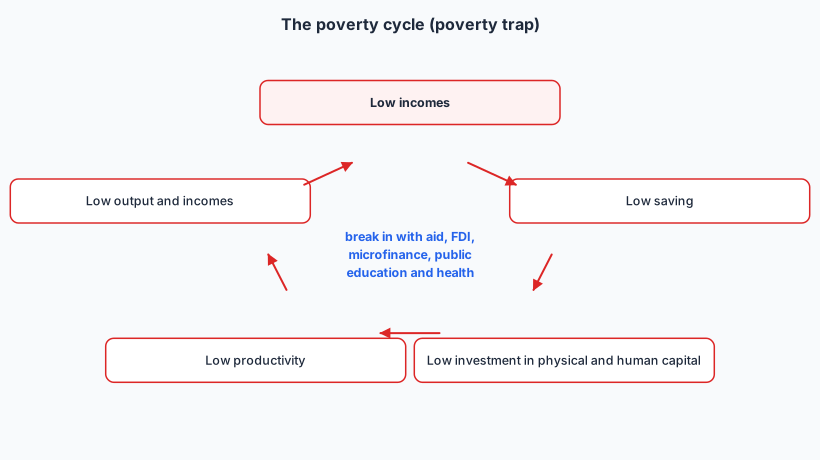
Other versions link poverty to poor nutrition and health (lower productivity), to children leaving school to work (low human capital), or to environmental degradation (4.7). Breaking the cycle usually needs an outside injection: aid, FDI, remittances, microfinance, or public investment in health and education.
Economic barriers
- Rising economic inequality: the poor cannot invest in education or businesses; demand is narrow; it can cause social instability and elite capture of policy (3.4).
- Lack of access to infrastructure and appropriate technology: poor roads, ports, power, water and internet raise costs and cut off rural producers from markets. Appropriate technology (suited to local skills and resources) may be missing.
- Low levels of human capital: lack of access to healthcare and education reduces productivity and adaptability; malnutrition and child stunting have lifelong effects.
- Dependence on primary sector production: commodities have low and volatile prices (low PED and PES, 2.6), low YED (world demand grows slowly), declining long-run terms of trade (the Prebisch–Singer hypothesis), few links to the rest of the economy, and exposure to the “resource curse” (Dutch disease, conflict, corruption).
- Lack of access to international markets: trade barriers in rich countries (especially on processed food and agriculture), rich-country farm subsidies, and difficulty meeting product standards.
- Informal economy: unregistered businesses and workers pay little tax, lack legal protection and access to credit, and have low productivity; governments lose revenue for public services.
- Capital flight: the transfer of money and assets out of a country by residents, legally or illegally, because of instability, fear of devaluation or to avoid tax. It drains savings and tax revenue needed for investment.
- Indebtedness: high foreign debt means large interest payments that divert revenue from health and education, discourage investment and may force austerity or default (Sri Lanka, 2022). Debt in foreign currency becomes more expensive when the currency depreciates.
- Geography, including landlocked countries: no coastline means higher transport costs and dependence on neighbours’ ports and politics (Laos, many African countries). Remoteness and mountainous terrain raise costs. Archipelagos like Indonesia face high inter-island logistics costs.
- Tropical climates and endemic diseases: malaria, dengue and other diseases reduce productivity and life expectancy; heat and extreme weather affect farming.
Political and social barriers
- Weak institutional framework:
- a legal system that cannot enforce contracts quickly and fairly discourages business;
- ineffective taxation structures: narrow tax bases, evasion and exemptions leave too little revenue for public goods;
- a weak banking system cannot channel savings to investment; many people have no access to credit;
- insecure property rights: without clear title, land cannot be used as collateral and there is little incentive to invest.
- Gender inequality: excluding women from education, work, finance and property wastes half the population’s talent; educated mothers have healthier, better-educated children.
- Lack of good governance and corruption: bribes raise business costs; public money is diverted; contracts go to the connected rather than the efficient; trust in government falls.
- Unequal political power and status: elites may block reforms (land reform, taxes, competition) that threaten their position; marginalized groups lack voice; conflict and instability destroy capital and deter investment.
Which barriers matter most?
There is no universal answer: the significance of different barriers depends on the country. Many economists (Acemoglu and Robinson, Why Nations Fail) argue that institutions are fundamental, because they shape incentives and determine whether other barriers are overcome; others stress geography and disease, or human capital. In an exam, pick a country, identify its most binding constraint with evidence, and explain how barriers interact (weak institutions → corruption → poor infrastructure and capital flight).
✏️Worked example
The barrier is dependence on primary sector production. Because supply is price inelastic in the short run, output cannot adjust, so export revenue falls sharply (roughly 30% on 80% of export earnings, about a 24% fall in total export revenue if volumes are unchanged). The terms of trade worsen: each unit of exports buys fewer imports.
Growth: lower export earnings reduce AD (X falls, with a multiplier effect) and the ability to import capital goods and inputs. Development: farmers’ incomes fall; government revenue from export taxes falls, so spending on health and education may be cut; the currency may depreciate, raising import prices; debt service becomes harder.
📝Practise
Tagged questions are modelled on a real IB question from that session, with our own wording and context.
1. [2 marks, Paper 2 style] Define the term capital flight.
2. [10 marks, Paper 1 (a) — modelled on May 2023 SL Paper 1 Q3(a)] Explain, with a diagram, how low incomes can keep a country poor through their effect on saving and investment.
3. [10 marks, Paper 1 (a) — modelled on November 2024 SL Paper 1 Q3(a)] Explain why a country that earns most of its export revenue from one crop may find it hard to sustain growth.
4. [10 marks, Paper 1 (a) — modelled on May 2024 SL Paper 1 Q3(a)] Explain how wealthy residents moving their savings abroad, and poor schooling, can each hold back growth.
5. [15 marks, Paper 1 (b) — modelled on May 2023 HL Paper 1 Q3(b)] Using real-world examples, discuss the importance of legal systems, property rights and corruption in explaining why some countries remain poor.
For: institutions (law, property rights, tax, banking, governance) determine incentives to invest; corruption diverts resources; weak tax systems starve public services; evidence from institutional economics (contrasts such as North and South Korea).
Against / other barriers: geography and disease (landlocked, tropical), commodity dependence, debt, low human capital, lack of market access; these can be binding even where institutions improve; barriers interact.
Judgment: institutions are often fundamental because they determine whether other barriers are tackled, but the most significant barrier varies by country; support with two contrasting examples.
6. [15 marks, Paper 1 (b) — modelled on November 2024 SL Paper 1 Q3(b)] Using real-world examples, examine how income inequality can hold back growth and development, compared with other economic barriers.
🔗Go deeper — other people’s work
These are external resources, not mine. If one stops working, tell me and everything above it on this page still stands.
- Daron Acemoglu and James Robinson, Why Nations Fail — the case for institutions.
- Abhijit Banerjee and Esther Duflo, Poor Economics — evidence on how poverty traps work in practice.
- Transparency International — the Corruption Perceptions Index.