What is a business?
🎯What you need to be able to do
- Describe the nature of business: inputs, processes and outputs, and the business functions.
- Explain the primary, secondary, tertiary and quaternary sectors, and how an economy’s sectoral structure changes.
- Explain entrepreneurship, and the difference between an entrepreneur and an intrapreneur.
- Explain the reasons for starting a business and the challenges and opportunities of start-ups.
📚The business management
The nature of business
A business is an organization that uses resources (inputs) to produce goods and services (outputs) that meet the needs and wants of customers. Most aim to make a profit, but some aim to meet a social need (1.2).
the factors of production: land (natural resources), labour (people), capital (machines, buildings, money) and enterprise (the entrepreneur who organizes them).
turning inputs into outputs: growing, manufacturing, assembling, delivering, advising. Businesses add value: the output is worth more to customers than the inputs cost.
goods (physical, tangible products) and services (intangible: a haircut, a flight, a bank account).
Inside a business, four functions work together, and they map onto the units of this course:
recruiting, training, motivating and organizing people (Unit 2).
raising money, recording and controlling it (Unit 3).
identifying and satisfying customer needs (Unit 4).
producing the good or service efficiently and at the right quality (Unit 5).
A decision in one function affects the others: a marketing campaign that doubles orders needs more staff, more finance for stock, and more capacity.
The four sectors of the economy
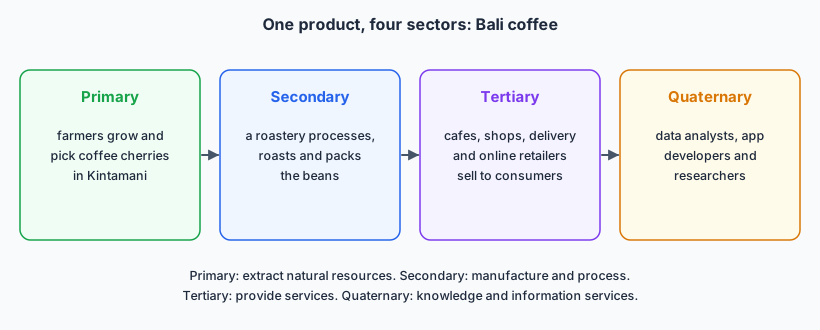
- Primary sector: extracting natural resources: farming, fishing, forestry, mining, oil and gas.
- Secondary sector: manufacturing and processing raw materials into finished goods: food processing, textiles, car assembly, construction.
- Tertiary sector: providing services to consumers and businesses: retail, tourism, banking, transport, healthcare, education.
- Quaternary sector: knowledge-based services: research and development, information technology, data analysis, consulting. Often treated as part of the tertiary sector but separated here because it is the fastest-growing part of advanced economies.
Sectoral change. As economies develop, employment and output move from the primary sector to manufacturing, and then to services and knowledge work. Higher incomes raise demand for services faster than for food; technology makes farming and manufacturing need fewer workers; and firms in rich countries move manufacturing to lower-cost countries. Deindustrialization is the decline of the secondary sector’s share.
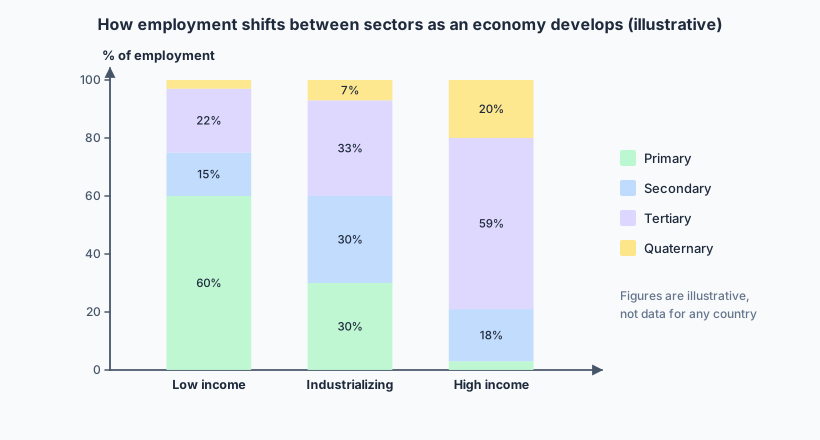
Sectoral change creates opportunities (new service and technology markets) and threats (declining demand, structural unemployment in shrinking industries). Indonesia fits the middle of this pattern: agriculture still employs a large share of workers, but services, from e-commerce to tourism, are growing fastest.
Entrepreneurship
An entrepreneur is a person who identifies a business opportunity and organizes the factors of production to exploit it, taking the risk of failure in return for potential profit. Entrepreneurs bring innovation, jobs and competition.
starts and runs their own business, bearing the financial risk personally.
an employee who acts like an entrepreneur inside an existing organization, developing new products or ventures with the firm’s resources and risk.
Why people start businesses: to be their own boss; to earn more than as an employee; to turn a hobby or skill into income; to exploit a gap in the market; to meet a social need; because of redundancy or a lack of other jobs (common in economies with large informal sectors); for challenge and self-fulfilment.
Challenges and opportunities for start-ups
Finance: raising start-up capital without a track record; high interest.
Cash flow: paying suppliers before customers pay.
Lack of experience and skills in marketing, accounts, HR.
Competition from established firms with brand loyalty and economies of scale.
Legal requirements: permits, taxes, registration.
Building a customer base and finding the right location.
Risk and stress: most start-ups fail within a few years.
Digital platforms cut the cost of reaching customers (online marketplaces, social media, food-delivery apps).
Crowdfunding, microfinance and business angels widen access to finance.
Gaps in the market that large firms ignore.
Government support: grants, subsidized loans (Indonesia’s KUR micro-loan scheme), incubators.
Flexibility: small firms can adapt quickly and build close customer relationships.
A business plan (toolkit) helps an entrepreneur test the idea, plan finance and persuade lenders and investors.
✏️Worked example
(a) Buying beans from farmers links to the primary sector (the farmers’ activity). Roasting and packing is secondary (processing). Selling online and to cafés is tertiary (retail and distribution). If he later analysed customer data to design new blends, that would be quaternary.
(b) Finance: a roaster, packaging equipment and a first batch of beans are expensive; with no trading record, banks may refuse a loan or charge high interest. Competition: established coffee brands have recognized names and economies of scale, so they can charge lower prices; Made must persuade buyers to switch.
(c) Online marketplaces and social media let him reach customers across Indonesia and tourists who visited Bali, without the cost of a shop. His story (single-origin beans, direct trade with local farmers) can be a unique selling point (4.2).
📝Practise
Work through these on paper, then reveal the answer. Mark allocations follow the style of IB Paper 1 and Paper 2.
1. [2 marks] Define the term entrepreneur.
2. [2 marks] Distinguish between the tertiary and quaternary sectors.
3. [4 marks] Explain two reasons why the share of employment in the primary sector usually falls as a country develops.
4. [4 marks] Explain the difference between an entrepreneur and an intrapreneur, with an example of each.
5. [4 marks] Explain how a decision in the marketing function might affect the operations and finance functions.
6. [10 marks] Discuss the challenges and opportunities for a young person starting an online clothing business in Indonesia.
Challenges: start-up finance for stock and branding; cash flow (paying suppliers before sales, marketplace payment delays, returns); fierce competition from established brands and cheap imports on the same platforms; lack of experience in marketing and accounts; building trust with buyers; logistics costs across islands.
Opportunities: very large and young online market; low set-up cost compared with a physical shop; social media marketing and influencers; access to micro-loans (KUR), crowdfunding or family funds; a niche (local fabrics, sustainable fashion) as a USP; flexible, low overheads.
Judgment: the opportunities are real, but success depends on a clear niche, careful cash flow management and starting small; a business plan helps test the idea. Top answers apply every point to the specific business and balance the two sides.
🔗Go deeper — other people’s work
These are external resources, not mine. If one stops working, tell me and everything above it on this page still stands.
- World Bank Open Data — employment in agriculture, industry and services, to see sectoral change country by country.
- Global Entrepreneurship Monitor — annual reports on start-up activity and attitudes, including Indonesia.
- Harvard Business Review — articles on entrepreneurship and intrapreneurship.