Budgets
🎯What you need to be able to do
- HL Explain the difference between cost and profit centres and their roles.
- HL Construct a budget.
- HL Calculate and interpret variances.
- HL Explain the importance of budgets and variances in decision-making.
📚The business management
Cost centres and profit centres
a section of a business (department, product line, location) to which costs can be allocated, but which does not directly generate revenue: HR, IT, maintenance.
a section for which both costs and revenues can be identified, so its profit can be calculated: each branch of a restaurant chain, each hotel, each product line.
Roles: help managers see which parts of the business perform well or badly; make managers accountable; aid decisions on pricing, investment and closure; can motivate managers who control their own centre. Problems: allocating shared overheads is arbitrary and can make a centre look unprofitable; centres may compete rather than cooperate; extra administration.
Constructing a budget
A budget is a detailed financial plan for a future period, setting targets for revenue, costs and profit. Budgets are usually based on the previous year’s figures adjusted for expected changes (incremental budgeting), sales forecasts and the business’s objectives; zero-based budgeting instead starts from zero and requires every item to be justified. Good practice: involve the managers who will be responsible, set realistic and SMART targets, and review regularly.
Variances
A variance is the difference between a budgeted figure and the actual figure.
better for profit than budgeted: actual revenue above budget, or actual costs below budget.
worse for profit: actual revenue below budget, or actual costs above budget.
Always label each variance F or A; the sign alone is ambiguous for costs.
Why budgets and variances matter
- Planning and coordination: departments work towards consistent targets.
- Control: variance analysis shows where performance departs from plan, so managers can investigate causes (“management by exception”).
- Accountability and motivation: managers own their budgets.
- Decision-making: adverse variances may lead to cost cuts, price changes or new forecasts; favourable ones to shifting resources to successful areas.
- Limitations: based on forecasts; can become rigid when conditions change; may encourage managers to pad budgets or spend unused money; a variance shows that something changed, not why.
✏️Worked example HL
Budgeted profit = 500 − 180 − 120 − 30 = 170. Actual profit = 470 − 170 − 132 − 26 = 142. Profit variance = 28 A (check: −30 + 10 − 12 + 4 = −28).
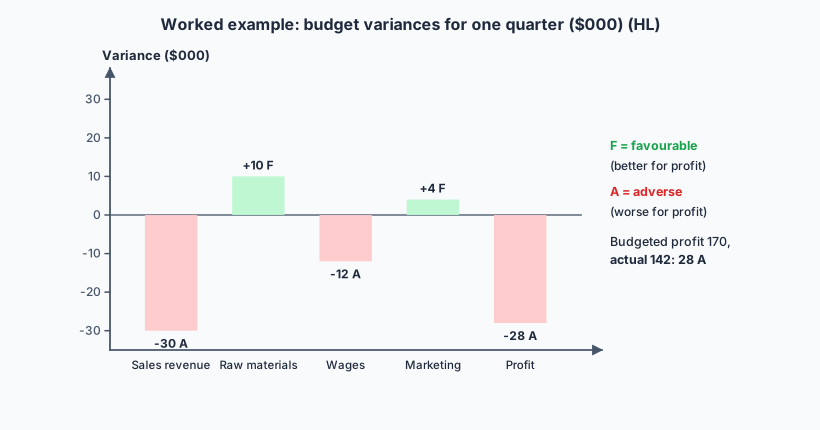
Comment: the main problem is sales 30 A. The favourable materials variance may simply reflect lower sales (less brewed), so it is not necessarily good news. Wages rose despite lower sales: overtime or a pay rise? The cut in marketing (4 F) may have contributed to lower sales. The brewery should investigate causes before acting.
📝Practise
All HL.
1. [2 marks] Distinguish between a cost centre and a profit centre.
2. [2 marks] Define the term adverse variance.
3. [3 marks] Budgeted revenue $80 000, actual $86 000; budgeted costs $60 000, actual $64 000. Calculate the variances and the profit variance.
4. [4 marks] Explain two possible causes of an adverse wage variance in a hotel.
5. [4 marks] Explain one benefit and one problem of making each branch of a restaurant chain a profit centre.
6. [10 marks] Discuss the importance of budgeting for a new social enterprise.
Budgets help plan limited resources, show donors, grant-givers and lenders that funds will be used responsibly, set targets for earned income, control costs, and highlight early when the mission is at risk. Variance analysis supports learning in an uncertain first year.
Limitations: little past data, so forecasts are uncertain; rigid budgets may prevent responding to opportunities; time-consuming for a small team.
Judgment: essential for credibility and survival, but should be flexible and reviewed often.
🔗Go deeper — other people’s work
These are external resources, not mine. If one stops working, tell me and everything above it on this page still stands.
- AccountingCoach — budgeting and variance analysis.
- CIMA — articles on zero-based and incremental budgeting.
- Tutor2u — revision notes on budgets and variances.