Introduction to marketing
🎯What you need to be able to do
- Explain market orientation and product orientation.
- Calculate and explain market share and market growth.
- HL Evaluate the importance of market share and market leadership.
📚The business management
What is marketing?
Marketing is the process of identifying, anticipating and satisfying customer needs and wants profitably. It includes market research, planning, product design, pricing, promotion and distribution: far more than advertising.
A market is where buyers and sellers exchange goods or services. Markets can be consumer (B2C, selling to individuals) or industrial (B2B, selling to businesses), and physical or online.
Market orientation and product orientation
the business starts from customer needs: it researches what customers want and designs products to meet them. Advantages: products more likely to sell; responsive to change; loyal customers. Disadvantages: research is costly; customers cannot always imagine radically new products; chasing trends may dilute the brand.
the business starts from what it can make and focuses on quality, efficiency and innovation, then looks for buyers. Advantages: strong on quality and technical innovation; can create new markets (many technology breakthroughs); efficient. Disadvantages: risk of making things nobody wants; slow to respond to changing tastes.
Most businesses combine both; product orientation remains common where technical expertise leads (pharmaceuticals, engineering, luxury craftsmanship).
Market share and market growth
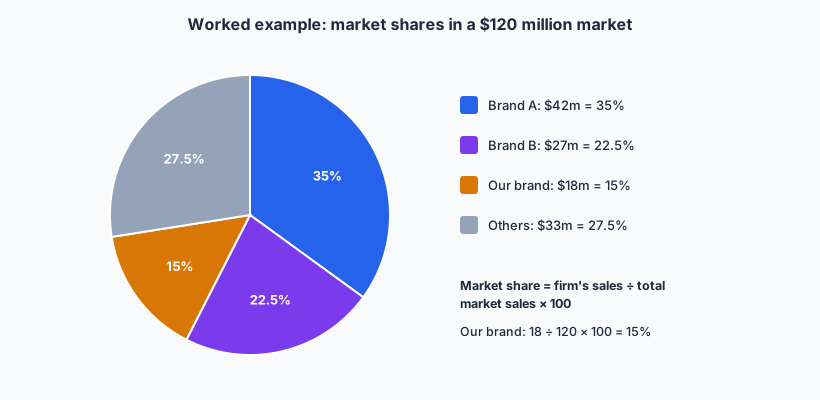
Market share can be measured by value (revenue) or by volume (units). A firm’s sales can grow while its share falls, if the market grows faster; and a falling market can hide a rising share.
Market share and market leadership HL
The market leader has the largest market share. Benefits: economies of scale and lower unit costs; brand recognition and customer trust; bargaining power with suppliers and retailers (better shelf space, better terms); ability to influence prices; higher profits to fund R&D and marketing; attractive to investors. Limitations: leadership invites competition and regulators’ attention; defending it is costly; a large share of a shrinking or unprofitable market is little comfort; complacency can let innovative rivals overtake (many former leaders in mobile phones and cameras).
✏️Worked example
(a) Market growth = (120 − 90) ÷ 90 × 100 = 33.3%. Share last year = 15 ÷ 90 × 100 = 16.7%; this year = 18 ÷ 120 × 100 = 15%.
(b) The brand’s sales grew by 20%, but the market grew by 33%, so it lost market share (16.7% to 15%). Rivals or new entrants are capturing more of the growth. The brand should investigate why, perhaps with market research, and review its marketing mix.
📝Practise
Work through these on paper, then reveal the answer.
1. [2 marks] Define the term market orientation.
2. [2 marks] A firm sells $4.2 million in a market worth $28 million. Calculate its market share.
3. [2 marks] A market grew from 2.4 million units to 2.7 million units. Calculate market growth.
4. [4 marks] Explain one advantage and one disadvantage of product orientation for a firm making high-end electric bicycles.
5. HL [4 marks] Explain two benefits of being the market leader for a snack food company.
6. [10 marks] Discuss whether a small business should aim to increase its market share.
For: economies of scale, stronger brand, bargaining power, security against competitors, more revenue.
Against: costly (price cuts, marketing) and may reduce profit; strains cash flow and capacity; large rivals may retaliate; a small firm may do better focusing on a profitable niche with loyal customers.
Judgment: depends on objectives, finance, the market’s growth and whether scale matters in the industry. A niche strategy (Porter’s focus, toolkit) may be more realistic than chasing overall share.
🔗Go deeper — other people’s work
These are external resources, not mine. If one stops working, tell me and everything above it on this page still stands.
- Philip Kotler, Principles of Marketing — the classic textbook.
- Statista and industry reports — market share data for many industries.
- Tutor2u — revision notes on market orientation and market share.