Research and development
🎯What you need to be able to do
- HL Explain the importance of research and development for a business.
- HL Explain the importance of developing goods and services that address customers’ unmet needs (of which they may or may not be aware).
- HL Explain the types of intellectual property protection: copyright, patents and trademarks.
- HL Distinguish between incremental and disruptive innovation.
📚The business management
Why R&D matters
Research and development is the systematic investigation of new ideas and their development into products, services or processes.
- Competitive advantage: unique products (a USP, 4.2) and premium prices.
- Extending the product portfolio: replacing products in decline (product life cycle).
- Process innovation: cheaper, faster, greener production.
- Growth and survival in fast-changing markets such as technology and pharmaceuticals.
But R&D is expensive and risky: most projects fail, returns are uncertain and slow, and success depends on the business culture, finance, the industry, competitors and government support. Small firms often struggle to fund it.
Unmet needs
Customers have needs they can state (a phone battery that lasts longer) and needs they are not aware of until a product appears (few people asked for ride-hailing apps or smartphones before they existed). Market research (4.4) uncovers stated needs; observing how people behave, their frustrations and workarounds reveals latent ones. Meeting unmet needs first can create whole new markets and first-mover advantage, but it is risky: customers may not understand or want the product.
Intellectual property protection
Intellectual property (IP) is a creation of the mind. IP rights let businesses earn a return on R&D and stop others copying.
- Patent: exclusive right to make, use and sell an invention for a fixed period (usually 20 years), in return for publishing how it works.
- Copyright: automatic protection of original creative work (text, music, software, film, designs) for the creator’s lifetime plus decades.
- Trademark: protection of a brand identifier (name, logo, slogan, sound) that distinguishes a firm’s products; renewable indefinitely.
IP rights encourage innovation and can be licensed to earn revenue, but registering and defending them is costly, enforcement is hard in some countries, and protection expires.
Incremental and disruptive innovation
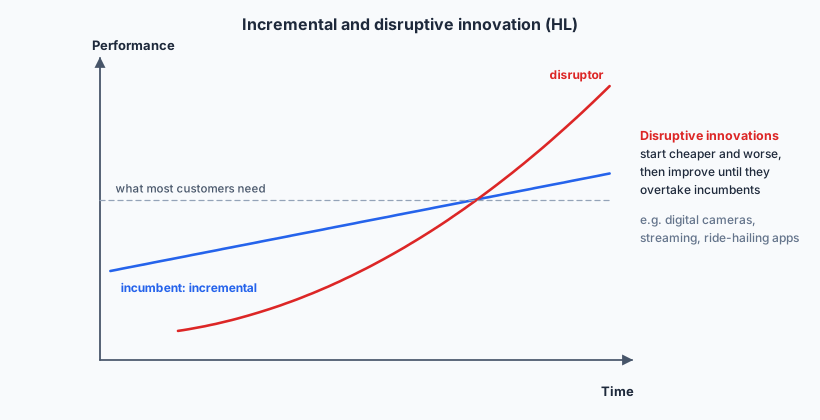
- Incremental innovation: small improvements to existing products or processes (a better camera in the next phone model). Low risk, keeps customers loyal, but easily copied and may not be enough when the market shifts.
- Disruptive innovation: a new product or business model that starts in a neglected or low-end segment, cheaper and simpler, then improves until it displaces established firms (digital photography, streaming, low-cost airlines).
✏️Worked example
Disruptive: the apps began as a new business model (independent drivers, app booking, upfront pricing), not a better taxi. They first served customers the taxi firm neglected (motorcycle rides, short trips, cashless payment), then added cars, food delivery and payments, overtaking the incumbent on convenience and price.
Response: the incumbent focused on incremental improvements to its existing service. It could have invested in its own app earlier, partnered with a platform (as some taxi firms later did), or used its brand and safety reputation as a differentiator.
📝Practise
Work through these on paper, then reveal the answer.
1. [2 marks] Define the term patent.
2. [2 marks] Distinguish between a copyright and a trademark.
3. [4 marks] Explain two reasons why a cosmetics company invests in R&D.
4. [4 marks] Explain the difference between incremental and disruptive innovation, using an example of each.
5. [10 marks] Discuss whether a small software start-up should spend its limited funds on patents.
For: protects a genuinely new invention from larger rivals; attracts investors (IP is an asset); can be licensed for revenue.
Against: expensive to file and defend internationally; software patents are hard to obtain in many countries; publishing the invention helps rivals design around it; speed to market and copyright on code may protect enough; cash may be better spent on development and customers.
Judgment: patent only a core, defensible invention in key markets; otherwise rely on copyright, trademarks, secrecy and speed.
🔗Go deeper — other people’s work
These are external resources, not mine. If one stops working, tell me and everything above it on this page still stands.
- Clayton Christensen — The Innovator’s Dilemma, the origin of the disruptive innovation idea.
- WIPO (World Intellectual Property Organization) — plain-language guides to patents, copyright and trademarks.
- DJKI (Indonesia’s Directorate General of Intellectual Property) — how IP is registered in Indonesia.