Growth and evolution
🎯What you need to be able to do
- Explain internal and external economies and diseconomies of scale.
- Explain the difference between internal and external growth.
- Evaluate the reasons for businesses to grow and to stay small.
- Evaluate external growth methods: mergers and acquisitions, takeovers, joint ventures, strategic alliances and franchising.
📚The business management
Economies and diseconomies of scale
Economies of scale are the reductions in average (unit) cost that come from increasing the scale of production. Diseconomies of scale are increases in average cost when a business grows too large.
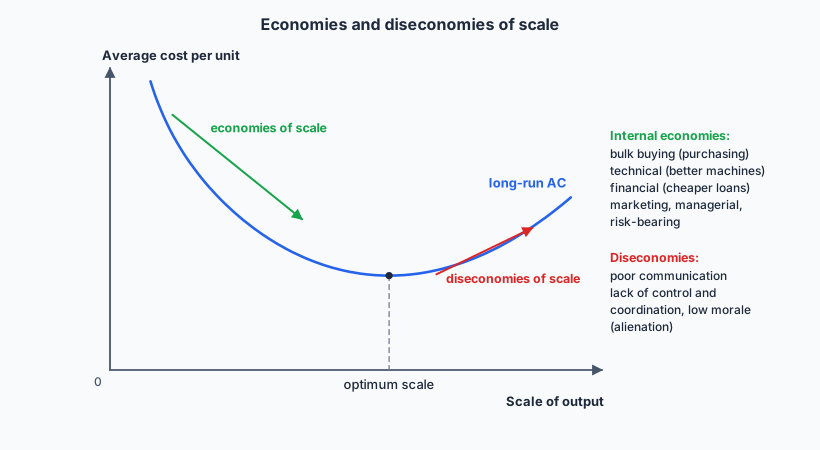
Internal economies of scale arise inside the business as it grows:
- Purchasing (bulk-buying): discounts for buying large quantities of materials.
- Technical: large firms can afford efficient, specialized machinery and spread its cost over more units.
- Financial: large firms can borrow more cheaply and raise share capital more easily.
- Marketing: the cost of an advertising campaign is spread over more sales.
- Managerial: specialist managers (finance, HR) are more efficient than one generalist.
- Risk-bearing: a wider range of products and markets spreads risk.
External economies of scale arise when the whole industry grows in an area: skilled local labour, specialist suppliers and infrastructure nearby, shared research (the cluster of silversmiths in Celuk, Bali, or tech firms in a city).
Internal diseconomies: poor communication across many layers; weaker control and coordination; low motivation as workers feel like small parts of a large machine (alienation). External diseconomies: industry growth in one area raises land prices, wages and congestion for every firm.
Internal versus external growth
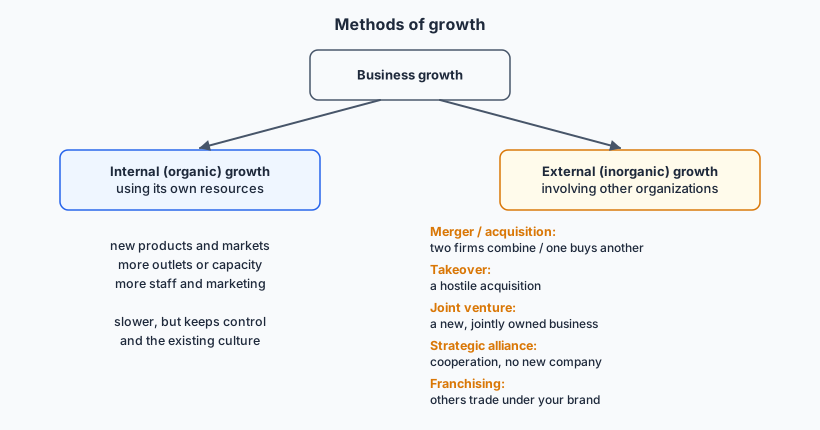
expanding using the business’s own resources: new products, new markets, more outlets, more capacity. Advantages: less risky, control kept, culture preserved, can be financed from retained profit. Disadvantages: slow; limited by the firm’s own finance; competitors may move faster.
growing by joining with or buying other businesses. Advantages: fast; instant access to new markets, brands, technology and customers; reduces competition; economies of scale. Disadvantages: expensive; risky; culture clashes (2.5); loss of control; redundancies and conflict.
Reasons to grow and to stay small
economies of scale and lower unit costs; higher market share and market power; survival (larger firms are harder to take over and better able to survive shocks); diversification of risk; higher profits; managers’ status and pay.
owners keep control; closer relationships with customers and staff; flexibility; serving a niche market; avoiding diseconomies of scale; limited finance; government support for small firms; lifestyle choice (a guesthouse owner who values time over profit).
External growth methods
- Merger: two businesses agree to combine into one new organization. Acquisition: one business buys a controlling stake (over 50%) in another, with agreement. The 2021 combination of Gojek and Tokopedia into GoTo was a merger of two Indonesian technology firms. Merger types: horizontal (same industry, same stage), vertical (backward towards suppliers or forward towards customers), conglomerate (unrelated industries).
- Takeover: an acquisition that is hostile: the target’s management does not agree, and the buyer purchases shares directly from shareholders. Only possible for publicly held companies.
- Joint venture: two or more businesses create a new, separate business that they own jointly, sharing costs, risks and profits. Common when entering foreign markets, where local partners bring market knowledge.
- Strategic alliance: businesses cooperate for a shared purpose while remaining independent and without forming a new company: airline alliances sharing routes and loyalty schemes; a bank and an e-wallet partnering on payments.
- Franchising: a franchisor grants a franchisee the right to use its brand, products and business model in return for an initial fee and ongoing royalties (a percentage of sales). Many minimarkets and fast-food outlets in Indonesia are franchised.
rapid growth with little capital (franchisees pay); motivated owner-managers; royalty income. But: less control over quality; one poor franchise can damage the brand; profits shared.
a proven model and known brand, training and support, lower risk than a new brand. But: fees and royalties; little independence (prices, suppliers, design set by the franchisor); contract may be ended.
✏️Worked example
(a) Average cost = total cost ÷ output: $9.00, $7.00, $5.50, $4.50, $4.00, $4.50.
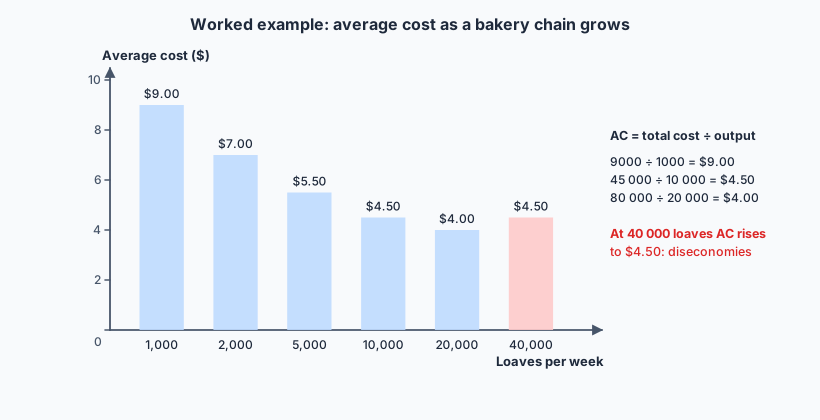
(b) Average cost falls from $9.00 to $4.00 as output rises to 20 000: economies of scale such as bulk-buying flour and using larger, more efficient ovens. The optimum scale in this data is 20 000 loaves, where average cost is lowest.
(c) At 40 000 loaves, average cost rises to $4.50: diseconomies of scale, for example the need for night shifts and extra managers, harder coordination between bakeries, and lower staff motivation.
📝Practise
Work through these on paper, then reveal the answer.
1. [2 marks] Define the term economies of scale.
2. [2 marks] Distinguish between a joint venture and a strategic alliance.
3. [4 marks] Explain two internal diseconomies of scale.
4. [4 marks] Explain two reasons why a business might choose to stay small.
5. [4 marks] A coffee chain charges franchisees a fee of $20 000 plus 6% of sales. A franchisee has annual sales of $400 000. Calculate the franchisor’s income from this outlet in the first year and explain one benefit to the franchisor.
6. [10 marks] A successful Indonesian snack brand wants to enter Thailand. Evaluate a joint venture with a Thai food company as the method of entry.
For: the partner brings local market knowledge, distribution networks and relationships with retailers; shares costs and risks; helps with regulations and cultural adaptation of flavours and marketing; faster than organic entry.
Against: profits shared; possible disagreements over strategy and control; culture clashes; risk that the partner learns the recipes and competes later; exit is complex.
Alternatives: exporting through a distributor (low risk, low control), franchising, acquisition (fast, costly), organic subsidiary (slow, full control).
Judgment: a joint venture is sensible when local knowledge is critical and the firm lacks experience abroad, if the agreement protects intellectual property and sets clear decision rights.
🔗Go deeper — other people’s work
These are external resources, not mine. If one stops working, tell me and everything above it on this page still stands.
- Harvard Business Review — articles on why so many mergers fail to create value.
- Indonesian Franchise Association (AFI) — how franchising works in Indonesia.
- News coverage of the Gojek–Tokopedia merger (2021) — a case study in external growth.