Business objectives
🎯What you need to be able to do
- Explain vision statements and mission statements.
- Explain common business objectives: growth, profit, protecting shareholder value and ethical objectives.
- Evaluate strategic and tactical objectives.
- Evaluate corporate social responsibility (CSR).
📚The business management
Vision and mission statements
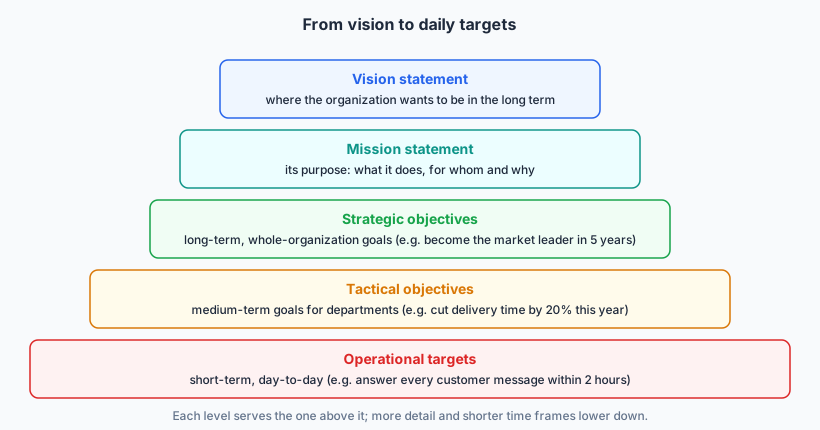
describes what the organization aspires to become in the long term: its ideal future. Short, inspiring and not time-bound. “A world where everyone can access clean water.”
describes the organization’s purpose: what it does, for whom, and why, often with its core values. More concrete than a vision. “We design affordable water filters for rural households and train local entrepreneurs to sell them.”
Why they matter: they communicate purpose to stakeholders, guide decisions and objectives, help motivate staff and attract employees and customers who share the values. Limitations: they can be vague, generic or public-relations exercises; they are hard to measure; and if actions contradict them, they damage trust.
Strategic, tactical and operational objectives
- Strategic objectives are long-term goals for the whole organization, set by senior management: become market leader, enter three new countries, become carbon neutral by 2035.
- Tactical objectives are medium-term goals for departments or functions that help achieve the strategy: raise online sales by 25% this year, reduce staff turnover to 10%.
- Operational objectives are short-term, day-to-day targets for teams and individuals.
Good objectives are usually SMART: specific, measurable, achievable, realistic (or relevant) and time-bound. “Increase profit” is not SMART; “increase profit margin from 8% to 10% by December 2027” is.
Evaluation: clear objectives coordinate the organization and allow performance to be measured. But objectives must change as the environment changes (a pandemic, new competitors, new regulation); rigid objectives can become out of date, and targets can cause short-termism or unethical behaviour if staff chase numbers at any cost.
Common business objectives
- Growth: increasing size (sales, market share, number of outlets). Brings economies of scale and security, but can strain cash flow and management (1.5).
- Profit: the surplus of revenue over costs, needed to survive, reward owners and fund investment. New businesses may aim first for survival and to break even.
- Protecting shareholder value: maximizing the value of shareholders’ investment through rising share prices and dividends. Important for publicly held companies; critics argue it encourages short-term decisions.
- Ethical objectives: aims based on moral principles: fair treatment of workers and suppliers, honest marketing, protecting the environment, fair trade sourcing.
Objectives change over time: a start-up aims to survive; an established firm to grow or maximize profit; a mature firm may emphasize shareholder value or ethical goals.
Corporate social responsibility (CSR)
CSR is a business’s commitment to behave ethically and to consider the impact of its activities on society and the environment, beyond what the law requires. Examples: reducing plastic packaging, paying suppliers fairly, supporting local education, ensuring safe conditions in supply chains, community programmes. Indonesian limited-liability companies in the natural-resources sector are legally required to carry out social and environmental responsibility programmes, which blurs the line between law and CSR.
better brand image and customer loyalty (especially among younger consumers); easier recruitment and higher staff motivation; good relations with communities and governments; attracts ethical investors; reduces the risk of scandals, boycotts and regulation; long-term sustainability of resources the business depends on.
costs (fair wages, cleaner processes) reduce short-term profit; conflict with shareholders focused on returns; benefits are hard to measure; risk of greenwashing accusations if claims are exaggerated; what counts as “ethical” differs between cultures and stakeholders.
Views differ: some argue a business’s only responsibility is to make profits within the law (the shareholder view); others that it must serve all stakeholders (the stakeholder view). Many firms now report a triple bottom line: people, planet and profit.
✏️Worked example
(a) (i) Strategic: long-term, whole-business. (ii) Tactical: a one-year goal for one department that supports the strategy. (iii) Operational: a daily routine task.
(b) This is a CSR decision. Benefits: it fits the mission, so it is credible to guests; fresh local produce improves food quality; it supports farmers and the community (good relations, local sourcing stories for marketing); lower transport emissions. Costs: higher food costs reduce the profit margin; supply may be less reliable in poor seasons. Judgment: for a resort positioning itself as eco-friendly, the premium is likely to pay back through reputation and higher room rates, provided it communicates the policy to guests and plans for supply shortfalls.
📝Practise
Work through these on paper, then reveal the answer.
1. [2 marks] Define the term mission statement.
2. [2 marks] Distinguish between a strategic objective and a tactical objective.
3. [4 marks] Explain two reasons why a business might change its objectives over time.
4. [4 marks] Explain why an objective should be SMART, using an example.
5. [4 marks] Explain one way in which pursuing shareholder value might conflict with ethical objectives.
6. [10 marks] Discuss whether a fast-fashion clothing retailer should adopt a stronger CSR policy.
For: growing consumer concern about waste and working conditions; reputational risk from factory accidents or pollution scandals; young consumers and employees favour ethical brands; regulation on supply chains is tightening; circular models (recycling, resale) can open new revenue.
Against: the business model relies on low costs and rapid turnover; higher wages and sustainable materials raise prices, which price-sensitive customers may reject; shareholders may resist lower margins; risk of greenwashing claims if changes are superficial.
Judgment: a gradual, verifiable CSR strategy (transparent supplier audits, recycling schemes) is likely to protect long-term sales and reputation, but the retailer must balance costs; the answer depends on its target market and competitors.
🔗Go deeper — other people’s work
These are external resources, not mine. If one stops working, tell me and everything above it on this page still stands.
- Company websites — compare the vision and mission statements of firms you know, and ask whether their actions match.
- UN Global Compact — principles and case studies on corporate responsibility.
- B Lab (B Corporation) — how firms are certified for social and environmental performance.