Cash flow
🎯What you need to be able to do
- Explain the difference between profit and cash flow.
- Explain working capital, the working capital cycle and the liquidity position.
- Construct and interpret cash flow forecasts.
- Explain the relationship between investment, profit and cash flow.
- Evaluate strategies for dealing with cash flow problems.
📚The business management
Profit is not cash
Profit is revenue minus costs over a period, recorded when sales are made. Cash flow is the actual movement of money into and out of the business. They differ because:
- Credit sales: a sale counts as revenue now, but the cash arrives when the customer pays, perhaps 60 days later.
- Credit purchases: costs are recorded when goods are received but paid later.
- Capital expenditure: buying a machine uses a lot of cash now, but only the depreciation appears as a cost each year.
- Stock: cash spent on stock not yet sold is not yet a cost in the profit and loss account.
- Loans and share capital bring in cash but are not revenue; repaying loans uses cash but is not a cost.
So a profitable business can run out of cash (fast growth, generous credit to customers) and a loss-making one can have cash for a while (from a loan).
Working capital
Working capital is the money available for day-to-day operations. The working capital cycle is the time between paying for inputs and receiving cash from customers:
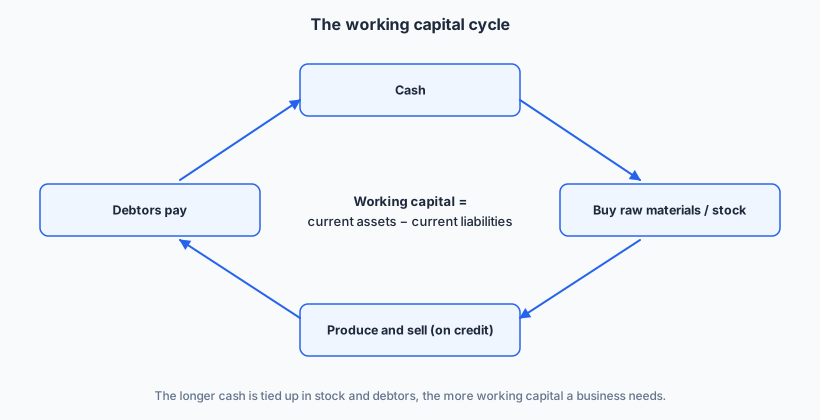
The liquidity position is the business’s ability to meet short-term obligations; measured by the current and acid test ratios (3.5) and monitored with cash flow forecasts.
Cash flow forecasts
A cash flow forecast predicts cash inflows and outflows, usually month by month, to show when the business may be short of cash. The standard layout:
cash at the start of the month (= last month’s closing balance)
cash sales, receipts from debtors, loans, capital injections, asset sales
stock, wages, rent, utilities, loan repayments, equipment, tax
closing balance = opening balance + net cash flow
Uses: identifies periods of shortage in time to arrange an overdraft; supports loan applications; helps plan the timing of big purchases; a benchmark to monitor actual cash flow. Limitations: based on predictions of sales and costs that may be wrong; unexpected events (a customer failing to pay, a price rise); only as good as the assumptions.
Investment, profit and cash flow
Investment (buying assets, launching products) uses cash first; profit and cash inflows come later, if at all. So a period of heavy investment usually weakens cash flow even when it will raise future profit. Growing businesses need finance for this gap, and poor timing of investment is a common cause of cash crises.
Dealing with cash flow problems
negotiate longer credit with suppliers; cut or delay spending (non-essential purchases, marketing); lease instead of buy; reduce stock levels; find cheaper suppliers. Risks: supplier relations, lower quality or growth.
chase debtors, give less credit, discounts for prompt payment, debt factoring; promotions to sell stock; sell unused assets or sale and leaseback. Risks: lost customers, lower margins.
overdraft for short gaps; short-term loan; new owners’ capital. Risks: interest, dilution.
✏️Worked example
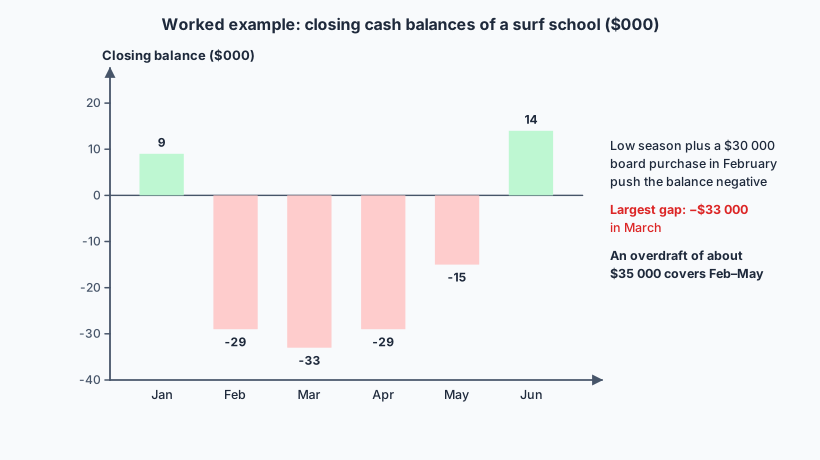
Recommendation: the shortage is temporary and caused by seasonality plus a one-off capital purchase. An overdraft facility of about $35 000 would cover the gap and is repaid by June. Better still, the boards (capital expenditure lasting several years) could be leased or bought with a medium-term loan, which removes most of the shortfall; the school could also delay the purchase to April or offer early-booking discounts to bring cash forward.
📝Practise
Work through these on paper, then reveal the answer.
1. [2 marks] Define the term working capital.
2. [2 marks] A shop’s opening balance is $4000; inflows $12 000; outflows $15 500. Calculate the closing balance.
3. [4 marks] Explain why a profitable business might run out of cash.
4. [4 marks] Explain two limitations of cash flow forecasts.
5. [4 marks] Explain how debt factoring can improve cash flow, and one drawback.
6. [10 marks] Discuss the strategies a small furniture manufacturer could use to deal with a cash flow problem caused by customers paying late.
Increase inflows: chase debtors, stop further credit to late payers, early-payment discounts, deposits on orders, factoring. Reduce outflows: negotiate supplier credit, cut stock of timber, delay non-essential spending. Finance: overdraft to bridge the gap.
Evaluation: tighter credit may lose customers who expect credit in the trade; discounts and factoring cut margins; supplier negotiation depends on relationships; an overdraft is quick but expensive. The root cause is credit control, so a policy of deposits and credit checks plus a short-term overdraft is a balanced solution.
🔗Go deeper — other people’s work
These are external resources, not mine. If one stops working, tell me and everything above it on this page still stands.
- Small business guides from banks — free cash flow forecast templates.
- AccountingCoach — the difference between profit and cash, and the cash flow statement.
- Tutor2u — revision notes on cash flow forecasting.