Efficiency ratio analysis
🎯What you need to be able to do
- HL Calculate and interpret stock turnover, debtor days, creditor days and the gearing ratio.
- HL Evaluate possible strategies to improve these ratios.
- HL Explain the difference between insolvency and bankruptcy.
📚The business management
Stock turnover
How many times stock is sold and replaced in a year, or how many days stock is held. Higher (times) is generally better: stock is not sitting idle, tying up cash, risking damage or obsolescence. It varies hugely by industry (a supermarket turns fresh food over very quickly; a jeweller slowly).
Debtor days
The average number of days customers take to pay. Lower is better for cash flow; compare with the credit period offered (a figure above 30 when terms are 30 days means customers pay late).
Creditor days
The average number of days the business takes to pay suppliers. Higher helps cash flow (suppliers fund the business for longer), but paying too slowly can damage relationships, lose discounts and lead to suppliers demanding cash. Ideally creditor days exceed debtor days.
Gearing
The proportion of long-term capital financed by borrowing. Above about 50% is usually considered highly geared: interest payments are a heavy fixed cost, profits are vulnerable to interest-rate rises, and lenders may refuse further loans. Low gearing is safer but may mean the business misses out on cheap borrowing to grow.
Strategies to improve efficiency ratios
- Stock turnover: just-in-time ordering (5.6); clear slow-moving stock with discounts; narrower product range; better sales forecasting.
- Debtor days: tighter credit control and checks on new customers; discounts for early payment; penalties for late payment; debt factoring (selling debts to a specialist for immediate cash).
- Creditor days: negotiate longer credit terms, especially when the business is a large, reliable customer.
- Gearing: reduce by repaying loans (from retained profit or asset sales) or issuing shares; increase deliberately if borrowing is cheap and returns are high.
Insolvency and bankruptcy
a financial state: the business cannot pay its debts when they fall due (cash-flow insolvency) or its liabilities exceed its assets (balance-sheet insolvency). It may recover through restructuring, new finance or agreements with creditors.
a legal process, declared by a court, for an insolvent individual (such as a sole trader) who cannot pay debts; assets are sold to pay creditors. For companies, the equivalent process is usually called liquidation or administration.
A profitable business can become insolvent if cash runs out, which is why liquidity and cash flow matter as much as profit.
✏️Worked example HL
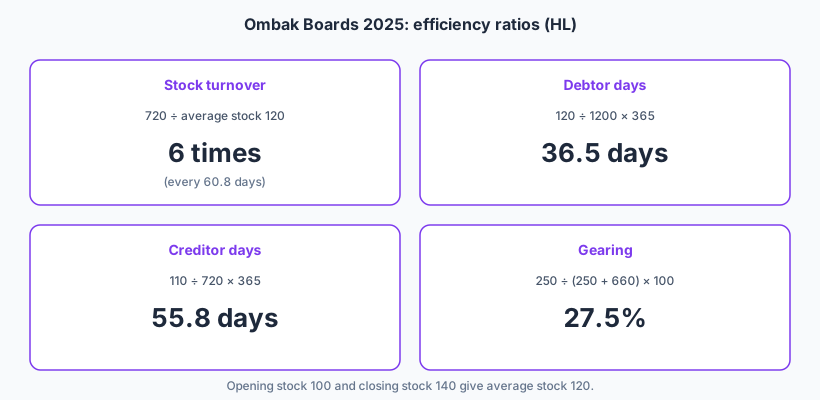
Average stock = (100 + 140) ÷ 2 = 120. Stock turnover = 720 ÷ 120 = 6 times a year (about 61 days).
Debtor days = 120 ÷ 1200 × 365 = 36.5 days: customers take longer than the 30 days allowed, so credit control could be tightened.
Creditor days = 110 ÷ 720 × 365 = 55.8 days: Ombak takes longer to pay suppliers than it waits for customers, which helps its cash flow, though very slow payment could strain supplier relations.
Gearing = 250 ÷ (250 + 660) × 100 = 27.5%: low gearing, so the business could borrow more to expand if needed.
📝Practise
All HL.
1. [2 marks] Cost of sales $480 000; opening stock $50 000; closing stock $70 000. Calculate stock turnover in times and days.
2. [2 marks] Debtors $45 000; sales $365 000. Calculate debtor days.
3. [2 marks] Non-current liabilities $600 000; equity $400 000. Calculate gearing and comment.
4. [2 marks] Distinguish between insolvency and bankruptcy.
5. [4 marks] Explain two ways a business could reduce its debtor days.
6. [10 marks] Discuss whether a company with gearing of 65% should take out a further loan to finance expansion.
For: if the expansion’s expected return exceeds the interest rate, borrowing raises returns to shareholders; owners keep control; interest may be tax-deductible.
Against: already highly geared; more debt raises fixed interest costs and the risk of insolvency if sales fall or interest rates rise; lenders may charge higher rates or refuse; credit rating may suffer.
Alternatives: share issue, retained profit, sale of assets, leasing.
Judgment: depends on the stability of profits, interest rates, the expansion’s risk and cash flow forecasts; many would recommend equity or a mix to bring gearing down.
🔗Go deeper — other people’s work
These are external resources, not mine. If one stops working, tell me and everything above it on this page still stands.
- AccountingCoach — inventory turnover, days’ sales in receivables and debt ratios.
- Investopedia — gearing and leverage explained.
- News coverage of company collapses — many profitable-looking firms failed from liquidity crises.