Communication
🎯What you need to be able to do
- Evaluate formal and informal methods of communication for an organization in a given situation.
- Explain barriers to communication.
📚The business management
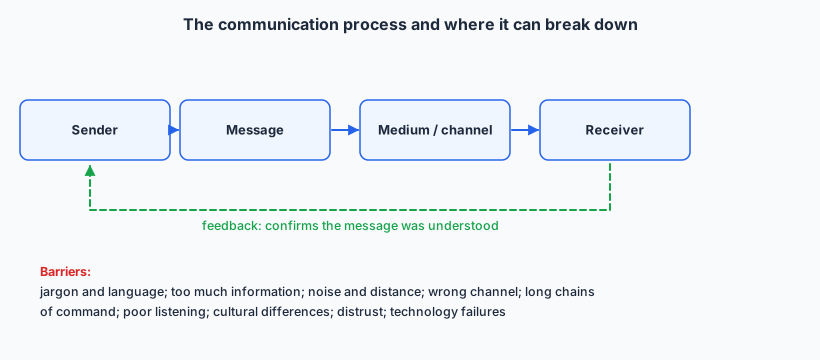
The communication process
Formal and informal communication
through official channels set by the organization: reports, memos, official emails, meetings, notices, appraisal forms, the intranet. Flows along the chain of command (vertical) or between departments (horizontal). Reliable, recorded and authoritative; can be slow and impersonal.
through unofficial channels: conversations, chat groups, social events, the “grapevine”. Fast, builds relationships and can reveal staff feelings; but can spread rumours and inaccurate information, and is not controlled.
Methods and when to use them:
- Face-to-face (one-to-one, team meetings): sensitive or complex messages, redundancies, feedback; allows questions and body language. Time-consuming; no written record unless minuted.
- Written (letters, reports, policies, email): detailed information, legal records, instructions to many people. Can be misread, overloaded, ignored.
- Digital and instant (messaging apps such as WhatsApp groups, video calls, intranets, collaboration tools): fast, reaches remote teams, cheap. Blurred work–life boundaries, information overload, security risks.
- Visual (charts, dashboards, infographics, noticeboards): data and safety instructions easy to grasp quickly.
Barriers to communication
- Language and jargon: technical terms or a second language the receiver does not share.
- Information overload: too many messages, so important ones are missed.
- Long chains of command: messages are delayed and distorted as they pass through many levels.
- Inappropriate medium: bad news by email; complex data read aloud.
- Physical distance and noise: remote teams, time zones, a noisy factory floor.
- Cultural differences: directness, formality and non-verbal signals vary across cultures.
- Attitudes and trust: receivers who distrust management may ignore or reinterpret messages; poor listening.
- Technology failures and lack of access (some staff without devices).
Overcoming barriers: choose the right channel for the message; use plain language; encourage feedback; flatten structures; train managers; translate key messages; combine methods (a meeting followed by written confirmation).
✏️Worked example
The message is sensitive (jobs and income), affects everyone differently, and will spread quickly through the grapevine. Recommendation: first brief supervisors face-to-face so they can answer questions; then hold a staff meeting (in Bahasa Indonesia and English where needed) led by the general manager, explaining the reasons and plans; follow with one-to-one meetings for the 40 staff affected; confirm details in writing (letters and a notice) so everyone has an accurate record; provide a contact for questions. Doing this on the same day prevents rumours on messaging groups filling the gap.
📝Practise
Work through these on paper, then reveal the answer.
1. [2 marks] Distinguish between formal and informal communication.
2. [2 marks] Define the term information overload.
3. [4 marks] Explain two barriers to communication in a multinational company.
4. [4 marks] Explain one advantage and one disadvantage of using a messaging app group for team communication.
5. [4 marks] Explain how the grapevine can both help and harm an organization.
6. [10 marks] Discuss how a company with a tall structure could improve communication.
Problems: long chain of command causes delay and distortion; top management far from customers and staff. Options: delayering (flatter structure, faster communication but wider spans and possible overload); intranet and collaboration tools (fast, but overload); regular all-staff meetings and open-door policies; empowering teams to communicate horizontally; training managers; feedback surveys.
Judgment: technology helps but does not fix cultural problems; combining modest delayering with clear channels and a culture of feedback is likely most effective, depending on cost and the firm’s need for control.
🔗Go deeper — other people’s work
These are external resources, not mine. If one stops working, tell me and everything above it on this page still stands.
- Erin Meyer, The Culture Map — how communication styles differ across countries.
- Mind Tools — communication skills and choosing the right channel.
- Harvard Business Review — articles on communication in remote and hybrid teams.