Investment appraisal
🎯What you need to be able to do
- Calculate and evaluate investment opportunities using the payback period and the average rate of return.
- HL Calculate and evaluate investment opportunities using net present value (NPV), with discount factors provided.
📚The business management
Payback period
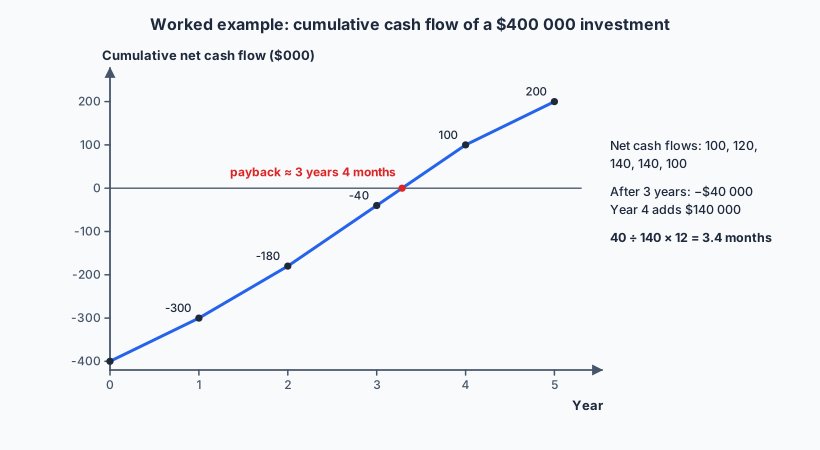
The payback period is the time it takes for the net cash inflows from an investment to repay its initial cost. Work out the cumulative net cash flow year by year; payback is when it reaches zero. If it happens part-way through a year:
simple and quick; focuses on liquidity and risk (a short payback returns cash sooner and is less exposed to uncertain far-future forecasts); useful in fast-changing industries.
ignores cash flows after payback (so ignores total profitability); ignores the time value of money; assumes cash flows are spread evenly within the year.
Average rate of return (ARR)
The average annual profit as a percentage of the initial cost. Compare it with the interest rate (the opportunity cost of the money) and with other projects.
uses all the cash flows; gives a percentage easy to compare with interest rates and targets.
ignores the timing of cash flows (a return in year 5 counts the same as in year 1); ignores the time value of money; relies on long-term forecasts.
Net present value HL
Money received in the future is worth less than money today, because today’s money could be invested to earn interest (and because of inflation and risk). Discounting converts future cash flows into their present value by multiplying by a discount factor (provided in the exam) for the chosen interest rate and year.
A positive NPV means the investment earns more than the discount rate: worth doing on financial grounds. A negative NPV means it would be better to invest the money at the discount rate.
accounts for the time value of money; uses all cash flows; a clear decision rule.
more complex; choosing the discount rate is subjective and changes the answer; still depends on uncertain forecasts.
Qualitative factors
Numbers are not the whole decision. Consider: how reliable the forecasts are; the business’s objectives (growth, CSR); risk and the economy; the impact on staff, customers and the environment; the source and cost of finance; competitors’ actions; and whether the project fits the strategy.
✏️Worked example
(a) Cumulative ($000): −400, −300, −180, −40, +100, +200. Payback falls in year 4: 40 ÷ 140 × 12 = 3.4 months, so about 3 years 4 months.
(b) Total returns = 600; profit = 600 − 400 = 200; per year = 200 ÷ 5 = 40.
(c) Present values ($000): 100 × 0.9259 = 92.59; 120 × 0.8573 = 102.88; 140 × 0.7938 = 111.13; 140 × 0.7350 = 102.90; 100 × 0.6806 = 68.06. Total = 477.56.
(d) The NPV is positive, the ARR (10%) exceeds an 8% cost of capital, and payback in under 3.5 years is reasonable for a machine lasting 5. Financially, Ombak should invest, provided the sales forecasts behind the cash flows are realistic (surf tourism can be volatile) and it can finance $400 000 without straining its cash flow; its low gearing (27.5%) suggests a loan is possible.
📝Practise
Work through these on paper, then reveal the answer.
1. [2 marks] A project costs $50 000 and returns $15 000 a year. Calculate the payback period.
2. [2 marks] A $200 000 machine returns $260 000 in total over 4 years. Calculate the ARR.
3. HL [3 marks] A project costs $100 000 and returns $60 000 in each of 2 years. Discount factors at 10%: 0.9091 and 0.8264. Calculate the NPV.
4. [4 marks] Explain why a business might prefer a project with a shorter payback even if its ARR is lower.
5. HL [4 marks] Explain how a rise in interest rates could change an NPV decision.
6. [10 marks] A hotel is choosing between solar panels (cost $150 000, ARR 12%, payback 6 years) and refurbishing rooms (cost $150 000, ARR 9%, payback 3 years). Discuss which investment it should choose.
Solar: higher ARR, long-term energy savings, CSR and brand benefits with eco-conscious guests; but long payback, reliant on energy-price forecasts, technology risk.
Refurbishment: faster payback helps liquidity, directly raises room rates and occupancy; but lower overall return and rooms will need refurbishing again.
Judgment: depends on the hotel’s cash position and gearing, its objectives (sustainability positioning vs short-term recovery), reliability of forecasts, and financing options (green loans for solar). A hotel with weak cash flow might refurbish first; one targeting eco-tourists might choose solar.
🔗Go deeper — other people’s work
These are external resources, not mine. If one stops working, tell me and everything above it on this page still stands.
- Khan Academy — Present value and the time value of money.
- Investopedia — payback period, ARR and NPV with examples.
- Tutor2u — investment appraisal revision notes and practice.