Marketing planning
🎯What you need to be able to do
- Explain the role of marketing planning.
- Explain segmentation, targeting and positioning, and construct position maps.
- Explain the difference between niche and mass markets.
- Explain the importance of a unique selling point/proposition (USP).
- Evaluate how organizations can differentiate themselves and their products from competitors.
📚The business management
The role of marketing planning
A marketing plan sets out marketing objectives and how to achieve them: an analysis of the current situation (market research, SWOT, competitors), objectives (SMART), the target market and positioning, the marketing mix (the seven Ps), the budget, and how results will be measured. Planning coordinates activities, focuses spending and gives targets to measure against; but plans take time, may be based on inaccurate research and must be updated as markets change.
Segmentation, targeting and positioning
- Segmentation: dividing a market into groups of customers with similar characteristics. Bases: demographic (age, gender, income, family size), geographic (region, urban/rural, climate), psychographic (lifestyle, values, personality), behavioural (usage rate, loyalty, benefits sought, occasion).
- Targeting: choosing which segment(s) to serve, based on size, growth, profitability, competition and fit with the firm’s strengths.
- Positioning: deciding how the product should be perceived by the target segment relative to competitors (“the affordable premium option”, “the eco-friendly choice”).
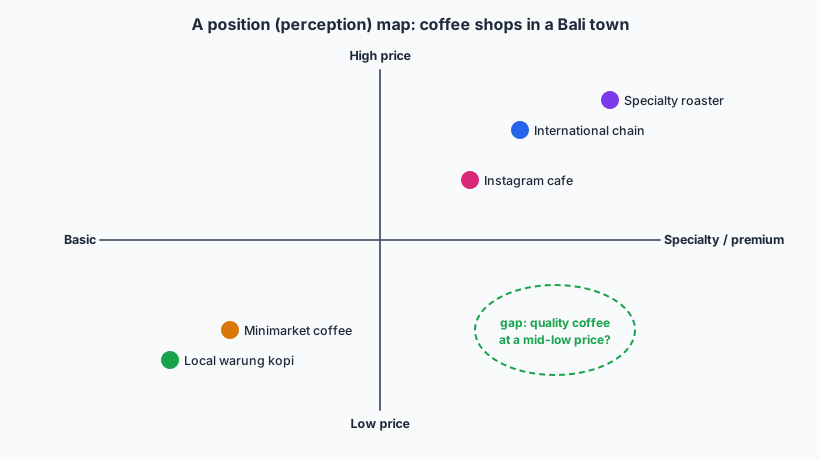
A position (perception) map plots competing brands on two dimensions that matter to customers, often price and quality. It shows where competitors cluster, where there are gaps, and where a new product could be positioned. Limitations: only two variables; based on perceptions that differ between customers; a gap may exist because there is no demand there.
Niche and mass markets
a small, specialized segment with specific needs: vegan skincare, surfboards for beginners, halal cosmetics for a specific group. Less competition, loyal customers, premium prices; but small size limits growth, vulnerable to changes in taste and to large firms entering.
a large market with broadly similar needs, served with standardized products: instant noodles, soft drinks. Economies of scale and large sales; but intense competition, price pressure, heavy marketing costs.
USPs and differentiation
A unique selling point/proposition (USP) is a feature or benefit that makes a product different from and better than competitors’ in the eyes of customers. It gives a reason to buy, supports premium pricing and builds brand loyalty.
Ways to differentiate: product features and quality; design; brand image and heritage; customer service; speed or convenience of delivery; sustainability and ethical credentials; location; technology; pricing (low-cost leadership); after-sales support. Differentiation works only if customers value the difference, and it must be hard for rivals to copy.
✏️Worked example
Competitors cluster at two ends: expensive specialty cafés aimed at tourists and cheap basic coffee from warungs and minimarkets. The map shows a possible gap for good-quality coffee at a mid-to-low price, targeting local students and young workers (a demographic and behavioural segment: frequent buyers who value quality but are price-sensitive).
Positioning: “specialty coffee for everyday”. USP: single-origin Kintamani beans roasted in-house, sold at warung-like prices through a small menu, fast service and a loyalty app. Check the gap: market research is needed to confirm demand, because a gap on a map is not proof that customers want it.
📝Practise
Work through these on paper, then reveal the answer.
1. [2 marks] Define the term market segmentation.
2. [2 marks] Distinguish between a niche market and a mass market.
3. [4 marks] Construct a position map for four smartphone brands using price and camera quality, and identify a gap.
4. [4 marks] Explain two bases a resort could use to segment its market.
5. [4 marks] Explain why a USP is important for a new business entering a competitive market.
6. [10 marks] Discuss whether a batik producer should target a niche market of international luxury buyers or the mass domestic market.
Niche luxury: premium prices, heritage and craftsmanship as USP, less competition from cheap printed batik; but small market, high marketing and export costs, dependent on tourism and foreign tastes.
Mass domestic: large, steady demand (batik worn for work and ceremonies), economies of scale; but intense competition, price pressure from printed and imported fabrics, lower margins.
Judgment: depends on production method (hand-drawn tulis batik suits niche; stamped or printed suits mass), capacity, finance and brand; a firm could run two brands for two segments.
🔗Go deeper — other people’s work
These are external resources, not mine. If one stops working, tell me and everything above it on this page still stands.
- Harvard Business Review — articles on segmentation and positioning.
- Tutor2u — position mapping explained with examples.
- Brand websites — compare how competing brands describe what makes them different.