Leadership and management
🎯What you need to be able to do
- Explain the difference between management and leadership.
- Evaluate autocratic, paternalistic, democratic, laissez-faire and situational leadership.
- HL Explain scientific and intuitive thinking and management.
📚The business management
Management and leadership
achieving objectives by planning, organizing, commanding, coordinating and controlling resources (Henri Fayol’s functions of management). Focus on systems, efficiency and the present. Authority comes from position.
influencing and inspiring people to work towards a vision; setting direction, building trust, driving change. Focus on people and the future. Influence can come from personality, expertise or respect, not only position.
Good managers often lead, and leaders need management skills; the distinction is one of emphasis.
Leadership styles
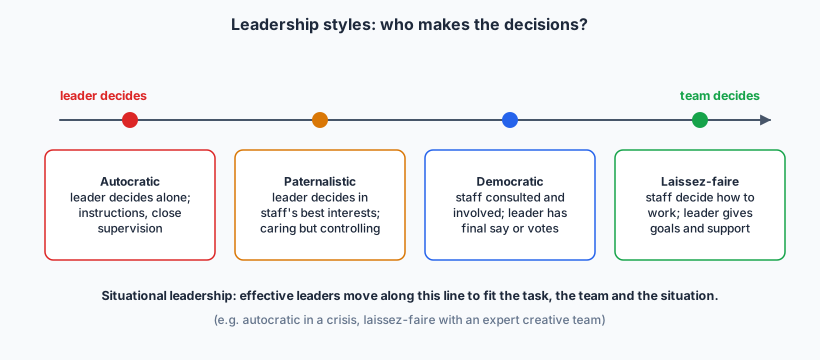
The leader makes decisions alone and gives instructions; one-way communication; close supervision.
Works: in a crisis, with unskilled or new staff, when decisions must be fast and consistent (military, emergency services).
Risks: low motivation and creativity, dependence on the leader, high staff turnover.
The leader decides, but in what they believe is the best interest of employees, like a parent: caring about welfare, explaining decisions, offering benefits.
Works: in family businesses and cultures that value hierarchy and loyalty.
Risks: staff may feel patronized; still little real participation.
Staff are consulted and participate in decisions; two-way communication; the leader may keep the final say or decide by majority.
Works: with skilled, motivated staff; when commitment and ideas matter.
Risks: slow decisions; possible conflict; not suitable in emergencies.
The leader sets goals and provides resources but leaves staff to decide how to achieve them; minimal interference.
Works: with highly skilled, self-motivated experts (researchers, designers).
Risks: lack of direction and coordination; some staff feel unsupported; deadlines slip.
Situational leadership: the most effective style depends on the situation: the task (routine or creative, urgent or not), the followers (their skills, experience and motivation), the leader’s own skills and the organizational culture. A good leader adapts, for example directing a new team member closely and delegating to an experienced one. Hersey and Blanchard’s model links the style to followers’ readiness: telling, selling, participating, delegating.
Scientific and intuitive thinking and management HL
decisions based on data, evidence and logical analysis: research, forecasts, ratio analysis, decision trees and investment appraisal. Systematic and easy to justify to stakeholders, but slow, costly, and only as good as the data; it can miss qualitative factors.
decisions based on experience, gut feeling and judgment. Fast and useful when data are missing or the situation is new, and can spot opportunities others miss; but it is open to bias, hard to justify, and risky when experience does not fit the new situation.
Most good decisions combine both: data to inform, judgment to interpret. The toolkit supplies the scientific tools; the syllabus expects you to recognize their limitations too.
✏️Worked example
An autocratic style suited the early stage, when the founder knew every detail and speed mattered. Now the staff are skilled professionals; being excluded from decisions is likely demotivating them, and high turnover of developers is costly (recruitment, lost knowledge, delayed projects).
Recommendation: move towards a democratic style for product decisions, with laissez-faire elements for experienced teams in how they complete their work, while keeping clear goals and deadlines. This matches Herzberg’s motivators (responsibility, recognition) and Deci and Ryan’s need for autonomy (2.4). Risks: slower decisions and the founder may find it hard to let go; a situational approach (autocratic in a security incident, democratic for planning) addresses this.
📝Practise
Work through these on paper, then reveal the answer.
1. [2 marks] Distinguish between management and leadership.
2. [2 marks] Define the term paternalistic leadership.
3. [4 marks] Explain one situation in which an autocratic style would be appropriate, and why.
4. [4 marks] Explain two disadvantages of a laissez-faire leadership style.
5. HL [4 marks] Explain one advantage and one limitation of intuitive decision-making for a fashion retailer.
6. [10 marks] Evaluate the use of a democratic leadership style in a large hospital.
For: skilled professionals (doctors, nurses) have expertise leaders need; consultation improves decisions, commitment and retention; staff involvement helps implement changes to procedures.
Against: emergencies require fast, clear commands (autocratic); large size makes consultation slow and costly; conflicting professional views can delay decisions; accountability for safety must be clear.
Judgment: a situational approach: democratic for planning and policy, autocratic protocols in emergencies and for safety-critical routines.
🔗Go deeper — other people’s work
These are external resources, not mine. If one stops working, tell me and everything above it on this page still stands.
- Mind Tools — Leadership styles and the Hersey–Blanchard situational leadership model.
- Daniel Kahneman, Thinking, Fast and Slow — the psychology behind intuitive and analytical decisions.
- Harvard Business Review — What Leaders Really Do (John Kotter) on management versus leadership.