Introduction to finance
🎯What you need to be able to do
- Explain the role of finance for businesses.
- Distinguish between capital expenditure and revenue expenditure, with examples.
📚The business management
The role of finance
Businesses need finance to:
- start up: buy premises, equipment and initial stock before any revenue comes in;
- run day to day: pay wages, suppliers, rent and bills, bridging the gap between paying costs and receiving revenue (working capital, 3.7);
- grow: new outlets, new products, acquisitions (1.5);
- replace and upgrade worn-out or outdated assets;
- survive shocks: a fall in sales, a pandemic, late-paying customers;
- fund research and development and marketing campaigns that pay off later.
The finance function also records and reports financial performance (final accounts), analyses it (ratios), and helps managers plan and control (investment appraisal, budgets).
Capital and revenue expenditure
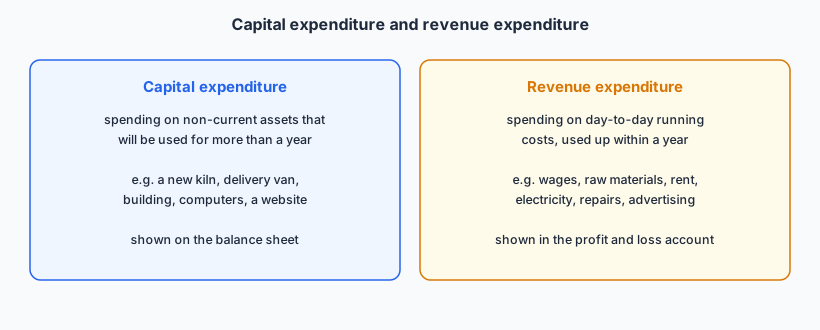
spending on non-current (fixed) assets that will be used for more than one year: land, buildings, machinery, vehicles, computers, software. Usually large and infrequent; financed by long-term sources; recorded as assets on the balance sheet and spread over time as depreciation.
spending on the day-to-day running of the business, used up within a year: wages, raw materials, rent, utilities, advertising, repairs and maintenance. Regular; financed from revenue or short-term sources; recorded as costs in the profit and loss account.
Why the distinction matters: it determines where spending appears in the accounts and therefore the profit figure; it guides the choice of finance (matching long-term assets with long-term finance); and misclassifying spending (treating a running cost as an asset) would overstate profit, which is why auditors check it.
✏️Worked example
Capital expenditure: (a) the kiln and (d) the website, both used for several years. Revenue expenditure: (b) clay and glazes, (c) the repair, and (e) wages.
The repair is the common trap: it keeps an existing asset working rather than creating a new one, so it is revenue expenditure. An upgrade that improves the kiln’s capacity for years would be capital expenditure.
📝Practise
Work through these on paper, then reveal the answer.
1. [2 marks] Define the term capital expenditure.
2. [2 marks] Distinguish between capital expenditure and revenue expenditure.
3. [2 marks] Classify: a delivery van; fuel for the van; insurance for the van; a new GPS system installed in the van.
4. [4 marks] Explain two reasons why a new business needs finance before it starts trading.
5. [4 marks] Explain why a business should normally finance capital expenditure with long-term sources.
6. [4 marks] Explain how misclassifying revenue expenditure as capital expenditure would affect a firm’s profit.
🔗Go deeper — other people’s work
These are external resources, not mine. If one stops working, tell me and everything above it on this page still stands.
- AccountingCoach — free explanations of capital and revenue expenditure.
- Company annual reports — look for “capital expenditure” (capex) in the cash flow statement.
- Investopedia — definitions of key finance terms.