Motivation and demotivation
🎯What you need to be able to do
- Evaluate the motivation theories of Taylor, Maslow and Herzberg.
- HL Evaluate McClelland’s acquired needs theory, Deci and Ryan’s self-determination theory, and equity and expectancy theory.
- HL Calculate and explain labour turnover; explain formative, summative, 360-degree and self-appraisal; evaluate internal and external recruitment and recruitment methods.
- Explain financial rewards (salary, wages, commission, PRP, profit-related pay, employee share ownership, fringe payments) and evaluate non-financial rewards (job enrichment, rotation, enlargement, empowerment, purpose, teamwork).
- Explain induction, on-the-job and off-the-job training.
📚The business management
Taylor: scientific management
F. W. Taylor (early 1900s) studied tasks with time-and-motion studies to find the one best way to do each job, then trained workers to follow it, supervised them closely and paid them by output (piece rate). He assumed workers are motivated mainly by money. Strengths: big productivity gains in repetitive work; influences fast-food and factory processes today. Limitations: ignores social and psychological needs; repetitive work causes boredom and alienation; quality may suffer when paid for quantity; conflicts with modern knowledge work.
Maslow: hierarchy of needs
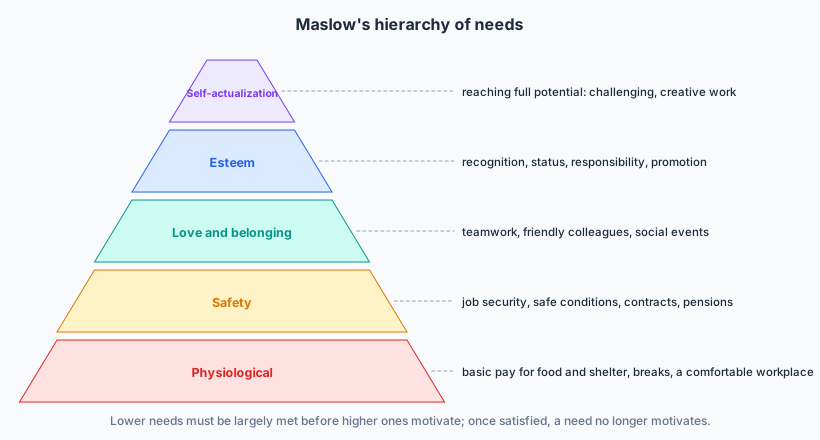
People are motivated by unmet needs, from basic to higher; a satisfied need no longer motivates, so managers should identify which level each employee has reached. Limitations: not everyone follows the order (an artist may seek self-actualization while poorly paid); levels are hard to measure; needs vary by culture (collectivist cultures may prioritize belonging); a single job can meet several levels at once.
Herzberg: two-factor (motivation–hygiene) theory
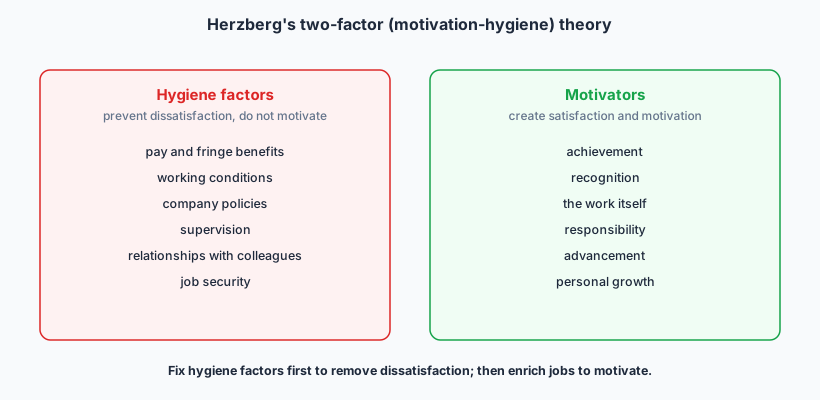
Hygiene factors, if poor, cause dissatisfaction, but improving them only removes dissatisfaction; they do not motivate. Motivators relate to the job itself and create real motivation. Implication: pay rises alone will not motivate for long; managers should enrich jobs. Limitations: based on a small study of accountants and engineers; for many low-paid workers, pay does motivate; people may credit themselves for satisfaction and blame the firm for dissatisfaction (a bias in the research method).
Further theories HL
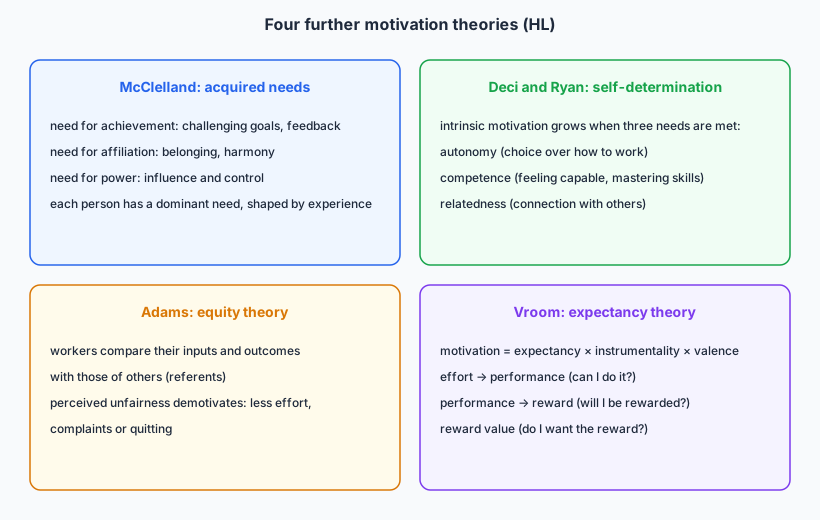
- McClelland’s acquired needs theory: people have a dominant need, learned from experience: achievement (want challenging goals and feedback: suit sales or entrepreneurial roles), affiliation (want to belong and be liked: suit team and customer roles), or power (want influence: may suit management). Managers should match roles and rewards to the dominant need.
- Deci and Ryan’s self-determination theory: intrinsic motivation (doing a task because it is satisfying) is stronger and longer-lasting than extrinsic motivation, and flourishes when three needs are met: autonomy, competence and relatedness. Heavy use of controlling rewards can crowd out intrinsic motivation.
- Equity theory (Adams): employees compare the ratio of their outcomes (pay, recognition) to inputs (effort, skills) with others’. Perceived inequity leads to reduced effort, demands for more, or quitting. Implication: transparent, fair pay structures.
- Expectancy theory (Vroom): motivation = expectancy (belief that effort leads to performance) × instrumentality (belief that performance leads to reward) × valence (how much the reward is valued). If any is zero, motivation is zero. Implication: set achievable targets, reward reliably, and offer rewards employees actually value.
Labour turnover HL
High turnover raises recruitment and training costs, loses experience and damages morale and service; it may signal poor motivation, pay or management. Some turnover is healthy (new ideas, removing poor performers) and some industries (hospitality, retail) naturally have high rates.
Appraisal HL
ongoing, developmental feedback during the year to help improvement.
a judgment of performance at the end of a period, often linked to pay or promotion.
views from managers, peers, subordinates and sometimes customers. Rounded but time-consuming and can be political.
employees assess their own performance. Encourages reflection; can be biased.
Recruitment HL
filling a vacancy from existing staff (promotion, transfer). Cheaper, faster, known performance, motivates staff; but no new ideas, creates another vacancy, may cause resentment.
hiring from outside through job websites, social media (LinkedIn), agencies, campus recruitment, referrals. Wider pool and fresh ideas; but more costly, slower, and riskier (unknown candidates) and new staff need induction.
The recruitment process typically runs: job analysis, job description and person specification, advertising, shortlisting, interviews and tests, selection, and induction.
Financial rewards
- Salary: a fixed annual amount paid monthly; security, but no direct link to output.
- Wages: paid per period worked. Time rate: per hour; piece rate: per unit produced (Taylor).
- Commission: a percentage of the value of sales made; motivates sales staff but can encourage pushy selling.
- Performance-related pay (PRP): bonus or increase linked to individual appraisal; motivating if targets are fair, divisive if not.
- Profit-related pay: a share of the firm’s profit; builds shared interest, but weak link to individual effort.
- Employee share ownership schemes: staff receive or buy shares; long-term loyalty and interest in company success.
- Fringe payments (benefits): non-wage benefits: health insurance, company car, meals, discounts, pensions.
Non-financial rewards
- Job enrichment: giving more challenging tasks and responsibility (Herzberg’s vertical loading).
- Job rotation: moving between tasks of similar difficulty; variety and multi-skilling, but may not add challenge.
- Job enlargement: adding more tasks at the same level (horizontal loading); variety but can feel like more work for the same pay.
- Empowerment: giving employees authority to make decisions about their work.
- Purpose / the opportunity to make a difference: meaningful work linked to a mission, especially powerful in social enterprises.
- Teamwork: working in teams meets social needs and can raise commitment and creativity.
Training
introduction for new employees: the organization, colleagues, rules, safety. Helps new staff settle and become productive faster.
learning while doing the job, from an experienced colleague (coaching, mentoring). Cheap and practical; may pass on bad habits and slow the trainer.
courses away from the workplace (college, online, training centre). Specialist expertise and focus; costly, and staff are away from work.
✏️Worked example
(a) Commission = 2% × 60 000 000 = Rp 1 200 000. Pay = 4 000 000 + 1 200 000 = Rp 5 200 000.
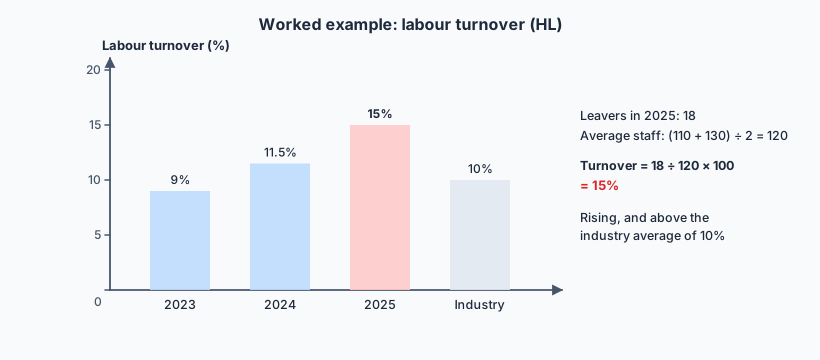
(b) Average staff = (110 + 130) ÷ 2 = 120.
Turnover has risen each year (9% → 11.5% → 15%) and is now 5 percentage points above the industry average. This suggests a problem with pay, conditions or management; each leaver adds recruitment and training costs. The firm should investigate through exit interviews and consider Herzberg’s hygiene factors (is pay competitive?) and motivators.
📝Practise
Work through these on paper, then reveal the answer.
1. [2 marks] Define the term job enrichment.
2. [2 marks] A worker is paid Rp 3500 per garment and produces 1200 garments in a month. Calculate their monthly pay and state the type of payment.
3. [4 marks] Using Herzberg’s theory, explain why a pay rise may not improve motivation in the long term.
4. HL [4 marks] Using expectancy theory, explain why a sales target might fail to motivate staff.
5. [4 marks] Explain one advantage and one disadvantage of off-the-job training for a hotel.
6. [10 marks] Discuss whether a ride-hailing company should rely mainly on financial rewards to motivate its drivers.
For financial rewards: drivers are often paid per trip (piece-rate-like), and many have low incomes, so pay meets physiological and safety needs (Maslow); incentives for peak hours match supply to demand (Taylor); bonuses are easy to measure.
Against relying on them: drivers are independent gig workers who value flexibility (autonomy, Deci and Ryan); perceived unfairness in pay rates or deactivations damages motivation (equity theory); hygiene factors such as safety and insurance matter; recognition (ratings, driver awards) and community support can add motivation cheaply.
Judgment: financial rewards are necessary but not sufficient; fair, transparent pay plus non-financial measures reduces turnover and protects service quality.
🔗Go deeper — other people’s work
These are external resources, not mine. If one stops working, tell me and everything above it on this page still stands.
- Daniel Pink, Drive — an accessible book on intrinsic motivation and self-determination theory.
- CIPD factsheets — reward, recruitment and performance appraisal.
- Mind Tools — summaries of Maslow, Herzberg, McClelland and Vroom.