Types of business entities
🎯What you need to be able to do
- Distinguish between the private and public sectors.
- Evaluate the main features of sole traders, partnerships, privately held companies and publicly held companies.
- Evaluate the main features of for-profit social enterprises (private and public sector companies, cooperatives) and non-profit social enterprises (NGOs).
📚The business management
Private and public sectors
businesses owned and run by private individuals or groups, usually to make a profit: from a warung to a listed conglomerate.
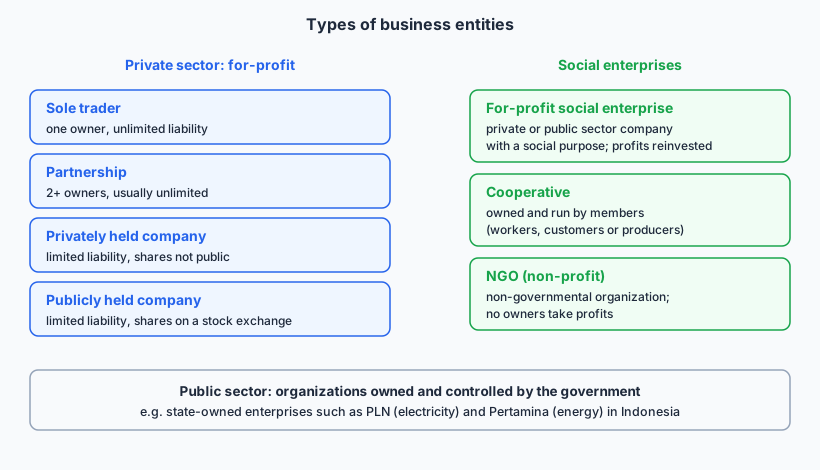
organizations owned and controlled by the government, providing services (schools, hospitals) or running state-owned enterprises (in Indonesia, BUMN such as PLN, Pertamina and state banks). Aims often include public service and national interest as well as profit.
Liability: the key idea
Unlimited liability means the owners are personally responsible for all the debts of the business: if it fails, they can lose their house and savings. Limited liability means owners can lose only the money they invested; the business is a separate legal entity (incorporated) that can own assets, sue and be sued. Limited liability makes it far easier to attract investors, which is why larger businesses are companies.
Sole traders
One owner, who may employ others. The most common form of business worldwide (in Indonesia, most micro-enterprises).
easy and cheap to set up; full control and quick decisions; owner keeps all the profit; privacy of accounts; close contact with customers.
unlimited liability; limited sources of finance (personal savings, small loans); heavy workload and no one to share decisions; lack of continuity (the business may end when the owner stops); hard to gain economies of scale.
Partnerships
Two or more owners (typically up to 20 in many countries) who share capital, decisions and profits, usually under a deed of partnership setting out each partner’s share. Common among lawyers, doctors and accountants.
more capital than a sole trader; shared workload and specialist skills; shared risk; still relatively private and easy to form.
usually unlimited liability (and partners are liable for each other’s business decisions); disagreements between partners; profits shared; continuity problems if a partner leaves or dies; capital still limited.
Privately held companies
An incorporated business with limited liability whose shares are not sold to the public; shares are held by the founders, family or selected investors and cannot be freely traded (in Indonesia, a PT).
limited liability attracts investors; more capital; continuity (the company outlives its owners); owners keep control over who buys shares.
legal costs and paperwork to set up; accounts must be filed (less privacy); cannot raise money from the public; shares hard to sell; profits shared among shareholders.
Publicly held companies
An incorporated business whose shares are traded on a stock exchange and can be bought by the public (in Indonesia, a PT Tbk listed on the Indonesia Stock Exchange). The first sale of shares to the public is an initial public offering (IPO).
access to very large amounts of share capital; limited liability; status and publicity; easier to borrow; economies of scale; shareholders can sell shares easily.
expensive and complex to go public; accounts published in detail; risk of takeover (anyone can buy shares); founders may lose control; pressure from shareholders for short-term profit; separation of ownership and control (managers may not act in shareholders’ interests).
Social enterprises
A social enterprise is a business whose main purpose is to achieve social or environmental goals, using trading activity to fund them. Profits are mainly reinvested in the mission rather than paid to owners.
- For-profit social enterprises may be private sector companies (a company that employs people from disadvantaged groups or sells products that solve a social problem, reinvesting most profit) or public sector companies (state-owned enterprises with a social purpose, such as a state water company serving remote areas at affordable prices).
- Cooperatives are owned and run by their members, who share the benefits, typically on a one-member-one-vote basis. Worker cooperatives are owned by employees; consumer cooperatives by customers; producer cooperatives by producers who pool resources (many Indonesian farmers’ and fishers’ koperasi, and village enterprises). Advantages: democratic control, motivated members, fair distribution; disadvantages: slow decisions, limited capital, members may lack management skills.
- Non-governmental organizations (NGOs) are non-profit social enterprises independent of government, funded by donations, grants and trading (the Red Cross, WWF, local community foundations). They have no owners taking profits. Advantages: trust, focus on the cause, tax benefits; disadvantages: unstable funding, dependence on donors, measuring impact is hard.
At HL, social enterprises are the subject of Paper 3.
✏️Worked example
For: as a company, the business gets limited liability: if the expansion fails, Ketut and Sari lose only what they invested, not their homes. The friend can become a shareholder with a clear, legally defined stake, which is easier to arrange than adding a partner. Banks are often more willing to lend to an incorporated business, helping fund the remaining Rp 0.8 billion. The company continues even if one owner leaves.
Against: setting up a company costs money and time (legal fees, registration, filing accounts). Accounts become less private. Profits are now shared with the friend, and Ketut and Sari may have to consult her on major decisions.
Judgment: because the expansion is large and risky relative to their savings, limited liability and access to equity finance outweigh the costs; a privately held company lets them raise capital while keeping control over who owns shares. They should set a shareholders’ agreement so that control is clear.
📝Practise
Work through these on paper, then reveal the answer.
1. [2 marks] Define the term limited liability.
2. [2 marks] Distinguish between a privately held company and a publicly held company.
3. [4 marks] Explain two disadvantages of operating as a sole trader.
4. [4 marks] Explain two features that make a cooperative different from a publicly held company.
5. [4 marks] Explain one advantage and one disadvantage for an NGO of relying on donations for funding.
6. [10 marks] A family-owned batik company is considering an IPO to fund expansion abroad. Discuss whether it should become a publicly held company.
For: large amounts of share capital without interest; limited liability continues; publicity and status help international expansion and borrowing; shares become easy to sell for family members who want to cash out.
Against: high costs of listing; loss of privacy; the family may lose control; risk of takeover; pressure from new shareholders for short-term profit may conflict with the brand’s heritage and craftsmanship (possible stakeholder conflict, 1.4).
Alternatives: loans, a joint venture with a foreign partner, private investors.
Judgment: depends on the size of funding needed, how much control the family wants to keep and market conditions; they could keep a majority stake to limit loss of control. A balanced conclusion earns the top band.
🔗Go deeper — other people’s work
These are external resources, not mine. If one stops working, tell me and everything above it on this page still stands.
- Indonesia Stock Exchange (IDX) — how IPOs work and which companies are listed.
- International Co-operative Alliance — the cooperative principles and examples from around the world.
- British Council and Social Enterprise UK — reports on social enterprise, including in Indonesia.