Stakeholders
🎯What you need to be able to do
- Explain the interests of internal and external stakeholders.
- Explain the possible conflicts between stakeholders and how they might be resolved.
📚The business management
Internal and external stakeholders
A stakeholder is an individual or group with an interest in, or affected by, the activities of a business.
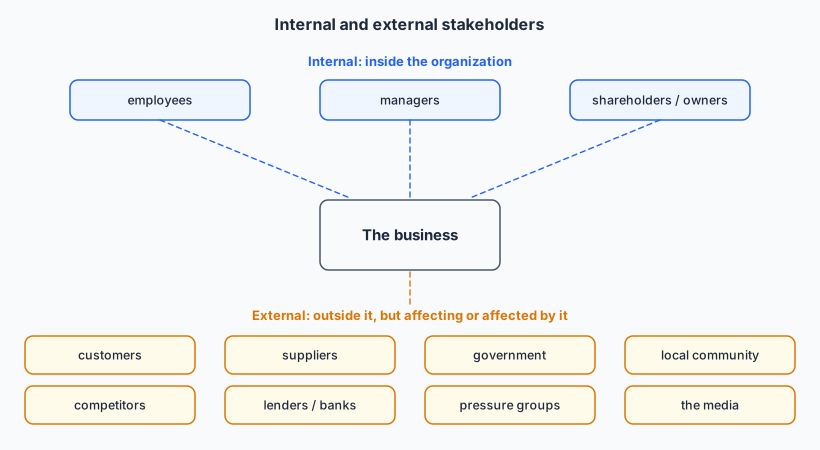
Employees: fair pay, job security, safe conditions, training, recognition.
Managers: salary and bonuses, power, career progression, achieving targets.
Shareholders / owners: profit, dividends, rising share value, and a say in major decisions.
Customers: quality, low prices, choice, good service.
Suppliers: regular orders, fair prices, prompt payment.
Government: tax revenue, jobs, compliance with the law.
Local community: jobs, low pollution, support for local causes.
Lenders: repayment with interest on time.
Pressure groups: ethical and environmental behaviour.
Competitors: fair competition, and information about rivals.
Media: newsworthy stories, and access to information.
Some people are in more than one group: an employee who owns shares; a customer who lives next to the factory.
Conflict between stakeholders
Because interests differ, a decision that benefits one group often costs another:
- Shareholders vs employees: cutting jobs or automating raises profit but reduces job security.
- Shareholders vs customers: higher prices raise profit; customers want lower prices.
- Business vs local community: expanding a factory creates jobs but increases traffic and pollution.
- Managers vs shareholders: managers may prefer growth and high salaries; shareholders want dividends.
- Business vs suppliers: paying suppliers later improves the firm’s cash flow but hurts the suppliers’.
Stakeholders can also share interests: a successful business benefits employees (security), government (tax) and suppliers (orders).
Managing conflict
- Prioritize using stakeholder mapping (Mendelow’s matrix): stakeholders with high power and high interest must be managed closely; high power, low interest kept satisfied; low power, high interest kept informed; low power, low interest monitored.
- Communicate and consult early, explaining the reasons for decisions.
- Compromise: phase in changes, offer retraining or redeployment rather than redundancies, share gains (profit-related pay).
- Align objectives through the mission and CSR, so stakeholders see a shared long-term interest.
A useful exam habit: for any decision in a case study, name the stakeholders affected, state how each is affected and why, identify who has most power, and suggest how the conflict could be reduced.
✏️Worked example
Shareholders gain: lower costs raise profit margins and the firm becomes more competitive against imports, protecting the share value. Employees lose: 200 people face redundancy and remaining workers may fear further cuts, lowering morale; if unionized, they may resist (2.7, HL). The local community loses income and spending in local shops; local government may object because of lost jobs. Customers may gain from lower prices or more consistent quality.
Reducing conflict: consult workers and their representatives early; phase the change in over time through natural wastage (not replacing leavers) and voluntary redundancy; retrain some workers to operate and maintain the machines; offer fair severance pay and help with finding new jobs. This costs money but protects reputation and relations with the remaining workforce and the community.
📝Practise
Work through these on paper, then reveal the answer.
1. [2 marks] Define the term stakeholder.
2. [2 marks] Distinguish between an internal and an external stakeholder, with an example of each.
3. [4 marks] Explain one possible conflict between a hotel’s shareholders and its local community.
4. [4 marks] Explain how stakeholder mapping could help a business manage conflict.
5. [4 marks] Explain why the interests of stakeholders may sometimes be the same.
6. [10 marks] A food company plans to reduce the sugar content of its best-selling drink by 40%. Discuss the likely impact on its stakeholders.
Customers: health-conscious buyers gain; others may dislike the taste and switch brands. Shareholders: reformulation costs and possible lost sales vs better reputation, avoiding a sugar tax and future regulation. Employees: may need retraining for new processes; job security depends on sales. Government and health groups: support the change (public health). Suppliers: sugar suppliers lose orders; sweetener suppliers gain. Media: positive coverage.
Judgment: most powerful stakeholders (government, many customers) favour it, and the long-term brand benefit likely outweighs short-term costs if the taste is maintained; a gradual change with marketing would reduce conflict.
🔗Go deeper — other people’s work
These are external resources, not mine. If one stops working, tell me and everything above it on this page still stands.
- Mind Tools — Stakeholder analysis and the power/interest grid, explained step by step.
- Business Roundtable’s 2019 statement on the purpose of a corporation — a debate about shareholder versus stakeholder priorities.
- Company sustainability reports — see how large firms describe their stakeholder engagement.