Multinational companies (MNCs)
🎯What you need to be able to do
- Explain what a multinational company (MNC) is and why businesses become multinational.
- Evaluate the impact of MNCs on host countries.
📚The business management
What is an MNC?
A multinational company (MNC) is a business that has its headquarters in one country (the home country) and operates (produces or provides services) in at least one other country (a host country). Selling abroad through exports is not enough; an MNC has operations, such as factories, offices or outlets, abroad.
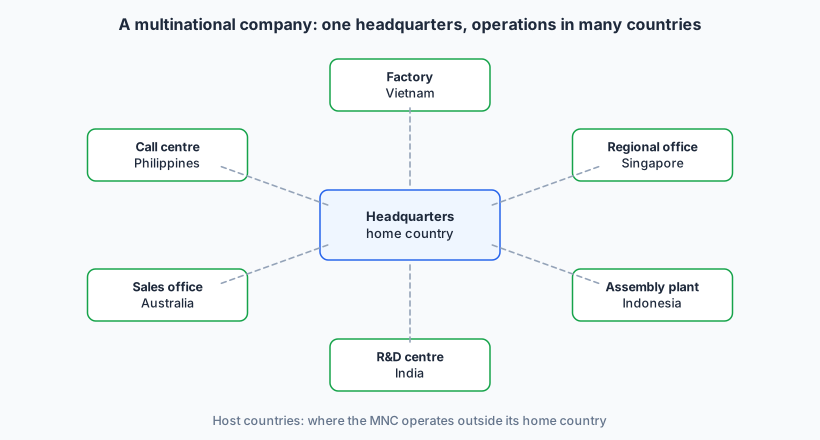
Why businesses become multinational: access to new markets and customers; lower production costs (labour, land, energy); access to raw materials; avoiding trade barriers by producing inside the market; economies of scale; spreading risk; tax advantages; closeness to customers to adapt products.
Examples in Indonesia include car makers (Toyota, Hyundai), consumer goods firms (Unilever, Nestlé), fast-food chains, and Chinese-owned nickel smelters. Indonesian firms also become MNCs: Indofood produces instant noodles in several countries.
The impact of MNCs on host countries
Jobs and income, directly and through local suppliers.
Investment (foreign direct investment) in factories and infrastructure.
Transfer of technology, skills and management know-how to local workers and firms.
Tax revenue for the government.
Exports and foreign exchange.
More choice and competition for consumers.
Higher standards for suppliers (quality, safety).
Profit repatriation: profits flow back to the home country.
Competition may drive local firms out of business.
Low wages or poor conditions in some cases; jobs may be low-skilled, with managers brought from abroad.
Environmental damage (pollution, deforestation).
Tax avoidance through transfer pricing and incentives demanded by MNCs.
Political influence over governments.
Footloose: an MNC can leave quickly, causing sudden job losses.
Cultural effects: erosion of local tastes and traditions.
What the impact depends on: the host government’s regulation and bargaining power (local-content rules, environmental and labour enforcement); the MNC’s own CSR; whether the MNC links to local suppliers and trains local staff; the sector (manufacturing that trains workers versus extraction with few jobs); and whether the host country’s own firms can learn and compete.
✏️Worked example
Benefits: 3000 direct jobs plus indirect jobs at suppliers, transport firms and local shops; training in electronics assembly and quality control; exports that earn foreign exchange; possible transfer of technology to local component suppliers if the MNC sources locally.
Costs: the tax holiday means little tax revenue for ten years; profits are repatriated; jobs may be low-skilled assembly with key technology kept abroad; if costs rise, the MNC could relocate to another country when the tax holiday ends.
Judgment: the impact is likely positive if the government negotiates local-content and training requirements, so that local firms and workers gain lasting skills; without them, benefits may be short-lived. It depends on the terms of the deal as much as on the MNC.
📝Practise
Work through these on paper, then reveal the answer.
1. [2 marks] Define the term multinational company.
2. [4 marks] Explain two reasons why a business might set up operations in another country.
3. [4 marks] Explain how an MNC could help local suppliers in a host country.
4. [4 marks] Explain two possible negative effects of an MNC on local businesses.
5. [4 marks] Explain what is meant by a “footloose” MNC and why it is a risk for a host country.
6. [10 marks] Discuss the impact of a large multinational mining company on a remote region of a developing country.
Positive: jobs, royalties and taxes for government, infrastructure (roads, power), local procurement, community programmes under CSR or law.
Negative: environmental damage (deforestation, water pollution), displacement of communities, few skilled jobs for locals, profit repatriation, dependence on one industry, social tension.
Judgment: depends on regulation, enforcement, revenue sharing with the region and the company’s CSR; the long-term impact may be negative if the mine closes without leaving skills or diversified industries.
🔗Go deeper — other people’s work
These are external resources, not mine. If one stops working, tell me and everything above it on this page still stands.
- UNCTAD World Investment Report — annual data and analysis of foreign direct investment by MNCs.
- Indonesia’s Ministry of Investment (BKPM) — data on foreign investment by sector and province.
- OECD Guidelines for Multinational Enterprises — expectations of responsible MNC behaviour.