Introduction to human resource management
🎯What you need to be able to do
- Explain the role of human resource management.
- Explain internal and external factors that influence human resource planning, such as demographic change, labour mobility, immigration, flexi-time and the gig economy.
- Explain the reasons for resistance to change in the workplace.
- Evaluate human resource strategies for reducing the impact of change and resistance to change.
📚The business management
The role of HRM
Human resource management is the management of an organization’s workforce: planning how many and what kind of employees are needed, and then recruiting, training, developing, motivating, rewarding, appraising and, when necessary, dismissing them. Good HRM links people decisions to the organization’s objectives: an airline planning new routes needs pilots and cabin crew trained and in place before the first flight.
Human resource (workforce) planning
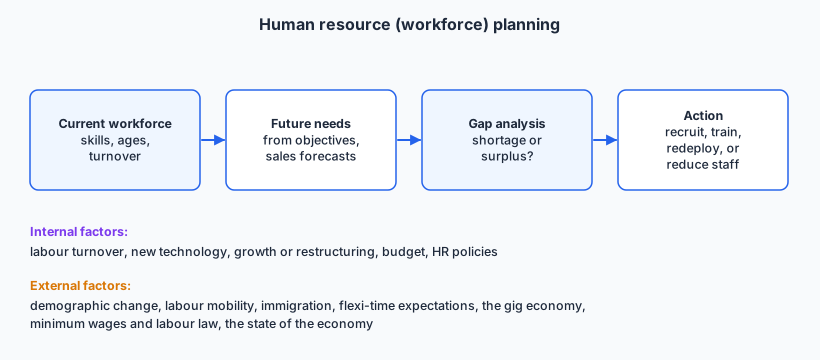
Internal factors: the organization’s objectives and growth plans; labour turnover and retirements; new technology (automation needs fewer but more skilled staff); restructuring; the HR budget.
External factors:
- Demographic change: an ageing population shrinks the labour supply in some countries; Indonesia’s young, growing workforce (a “demographic dividend”) offers plenty of potential recruits but demands job creation.
- Labour mobility: occupational mobility (ability to change job type, which depends on skills) and geographical mobility (ability to move location, which depends on housing, family, cost).
- Immigration and emigration: migrants can fill skills gaps; emigration of skilled workers (“brain drain”) creates shortages.
- Flexi-time and flexible working: employees increasingly expect flexible hours, part-time work and remote or hybrid work, especially since the pandemic.
- The gig economy: work organized as short-term tasks paid per job, often through apps (ride-hailing drivers, delivery riders, freelancers on online platforms). Gives firms flexibility and low fixed costs, but workers lack security, benefits and often bargaining power.
- Also: labour law (minimum wages, contracts), the state of the economy, education and training systems, competitors’ pay.
Resistance to change
Employees often resist change, even when it is in the organization’s interest, because of:
- Self-interest: fear of losing jobs, pay, status or power.
- Fear of the unknown and low tolerance of change: uncertainty about new roles or skills.
- Misunderstanding and lack of trust: poor communication about why change is needed.
- Different assessments: staff may genuinely believe the change is a mistake.
- Habit and comfort with existing routines, and loss of social relationships if teams are broken up.
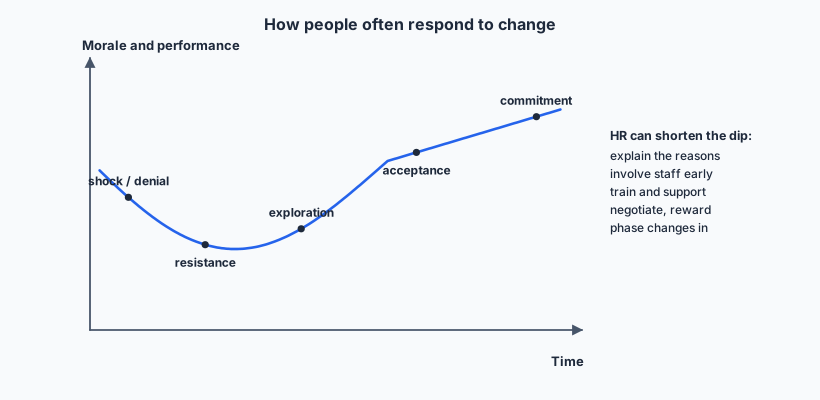
HR strategies for managing change
explain why change is needed, early and honestly. Cheap and builds trust, but takes time.
involve staff in planning; they gain ownership. Slower, and staff may push their own interests.
retraining, counselling, time to adjust. Reduces fear of new skills; costs money.
pay rises, bonuses or voluntary redundancy packages. Effective with unions; can be expensive.
introduce change gradually or test it in one site first. Lower risk; slower benefits.
imposing change by authority. Fast but damages morale and trust; a last resort.
The right mix depends on the urgency of the change, the power of employees and unions, the culture of the organization and the resources available. The HL toolkit’s force field analysis helps weigh the forces for and against a change.
✏️Worked example
(a) Replacing leavers: 20% × 120 = 24 a year, so about 36 over 18 months. Plus 60 for the new property: roughly 96 recruits (more, if new staff also leave at the same rate).
(b) Competition for skilled labour in a busy tourist area, as other hotels and restaurants expand after demand recovers; emigration of experienced chefs to jobs on cruise ships or abroad, which pay more; limited geographical mobility if chefs from elsewhere cannot afford local housing.
(c) Explain why the system is being introduced (fewer booking errors, faster check-in); involve senior receptionists in testing it; train all users before launch; run the old and new systems together for a short period; reassure staff about job security if that is true.
📝Practise
Work through these on paper, then reveal the answer.
1. [2 marks] Define the term gig economy.
2. [2 marks] Distinguish between occupational and geographical mobility of labour.
3. [4 marks] Explain two benefits to a business of using gig workers.
4. [4 marks] Explain two reasons why employees might resist the introduction of new technology.
5. [4 marks] Explain how an ageing population could affect a firm’s human resource planning.
6. [10 marks] Discuss the strategies a bank could use to reduce resistance when it closes branches and moves customers to digital banking.
Staff will fear redundancy and loss of status. Strategies: early, honest communication about the reasons (customers moving online, costs); participation (staff design the new customer-support roles); retraining branch staff for digital support, sales or call-centre roles; voluntary redundancy and early retirement packages; phasing closures; supporting staff through the change curve.
Evaluation: communication and retraining build trust but cost money and time; incentives are expensive; coercion is fast but damages morale and the bank’s reputation. A combination suited to the bank’s culture and union strength is best; consider the trade-off between speed of cost savings and staff goodwill.
🔗Go deeper — other people’s work
These are external resources, not mine. If one stops working, tell me and everything above it on this page still stands.
- International Labour Organization (ILO) — reports on the gig and platform economy.
- John Kotter, Leading Change — a classic model of managing organizational change.
- CIPD — free factsheets on workforce planning and change management.