Organizational (corporate) culture
🎯What you need to be able to do
- HL Describe organizational culture.
- HL Explain types of organizational culture, for example Charles Handy’s gods of management.
- HL Evaluate cultural clashes when organizations change, including when they grow and merge and when leadership styles change.
📚The business management
What is organizational culture?
Organizational (corporate) culture is the set of shared values, beliefs, norms and attitudes that influence how people in an organization think and behave. It shows in visible things (dress, office layout, stories, rituals, how meetings run) and in invisible ones (attitudes to risk, customers, hierarchy and mistakes). Culture is shaped by the founder and leaders, the organization’s history, its industry, national culture (Hofstede) and the people it recruits.
A strong culture, widely shared, gives direction, loyalty and consistent behaviour without heavy supervision; but it can resist change and silence dissent. A culture that fits the strategy is a source of competitive advantage.
Handy’s gods of management
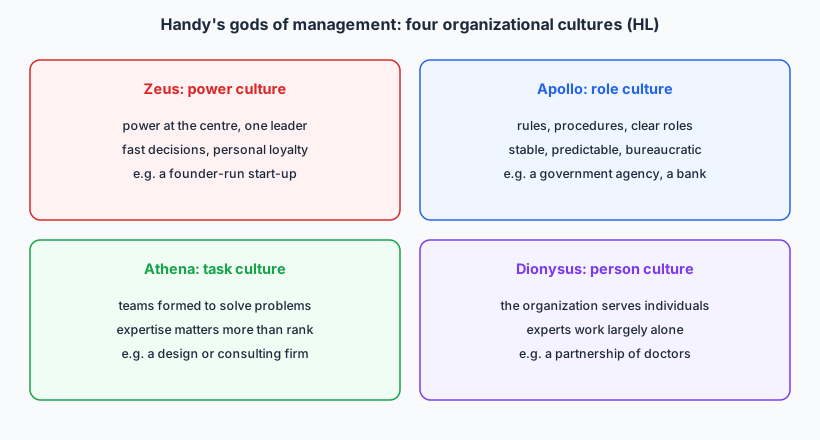
- Zeus (power culture): power radiates from one central figure (a web). Fast decisions, but depends on the leader and can be political.
- Apollo (role culture): power comes from position and rules (a temple of pillars). Efficient and predictable in stable conditions; slow to change.
- Athena (task culture): power comes from expertise; teams form around projects (a net). Flexible and creative; costly and hard to control.
- Dionysus (person culture): the organization exists to support talented individuals (a cluster). Suits professional partnerships; hard to manage.
Other typologies exist (for example Johnson and Scholes’s cultural web); the syllabus allows any, but Handy is the expected example.
Culture clashes
A culture clash occurs when groups with different cultures must work together, causing conflict, confusion and low morale. Common triggers:
- Growth: a small, informal Zeus-style start-up becomes larger and introduces procedures and managers (Apollo); early employees feel they have lost freedom and access to the founder.
- Mergers and acquisitions: two organizations with different values, decision styles and ways of working combine. Many mergers fail to deliver expected benefits because of culture clashes, not finance.
- New leadership styles: an autocratic new CEO in a democratic organization, or vice versa.
- Internationalization: different national cultures (attitudes to hierarchy, time, directness) in joint ventures and MNCs.
Effects: communication breakdowns, conflict, falling motivation and productivity, loss of key staff, failure to achieve merger synergies. Managing clashes: assess cultures before a merger (cultural due diligence); communicate a shared vision; involve staff from both sides; allow time and training; keep what works in each culture; lead by example.
✏️Worked example HL
(a) The hotel group is an Apollo (role) culture; the start-up is an Athena (task) culture, perhaps with Zeus features around its founder.
(b) If the group imposes its procedures, approvals and job descriptions, start-up staff may feel their autonomy and speed are lost; creative employees may leave, destroying the value the group paid for. Conversely, hotel managers may see start-up staff as undisciplined. Management: keep the start-up as a semi-independent unit with its own ways of working; agree shared goals (digital bookings) and a few essential standards; appoint a leader respected by both; retain key staff with incentives such as share or profit schemes.
📝Practise
All HL.
1. [2 marks] Define the term organizational culture.
2. [2 marks] Describe an Apollo (role) culture.
3. [4 marks] Explain two ways a strong organizational culture can benefit a business.
4. [4 marks] Explain why a culture clash might occur when a start-up grows rapidly.
5. [4 marks] Explain how differences in national culture could affect a joint venture between an Indonesian and a Scandinavian company.
6. [10 marks] Discuss the view that most mergers fail because of culture clashes.
For: culture determines how people work together; clashes cause conflict, lost key staff and failure to integrate systems; many well-known mergers struggled mainly for cultural reasons.
Against: other causes: paying too much, overestimated synergies, poor strategy, debt, market changes, regulatory problems; culture clash may be a symptom of poor integration planning.
Judgment: culture is a major and often underestimated cause, but rarely the only one; mergers with cultural due diligence and careful integration fail less often.
🔗Go deeper — other people’s work
These are external resources, not mine. If one stops working, tell me and everything above it on this page still stands.
- Charles Handy, Gods of Management — the original account of the four cultures.
- Edgar Schein, Organizational Culture and Leadership — artefacts, espoused values and underlying assumptions.
- Harvard Business Review — articles on culture in mergers and acquisitions.