Industrial/employee relations
🎯What you need to be able to do
- HL Explain the sources of conflict in the workplace.
- HL Evaluate the approaches of employees (collective bargaining, work-to-rule, strike action) and employers (collective bargaining, threats of redundancies, changes of contract, closure and lockouts).
- HL Evaluate conflict resolution: conciliation and arbitration, employee participation and industrial democracy, no-strike agreements and single-union agreements.
📚The business management
Sources of conflict
- Pay and benefits: wage demands, especially when inflation reduces real pay or profits are high.
- Working conditions and hours: safety, overtime, shift patterns, workload.
- Job security: redundancies, automation, outsourcing, contract changes.
- Change: new technology or methods, restructuring, relocation (2.1).
- Management style and treatment: unfair discipline, discrimination, poor communication.
- Different objectives: shareholders want lower costs; employees want higher pay and security.
Employees often act collectively through trade unions (labour unions): organizations of workers that negotiate on their behalf and give them more bargaining power than individuals. Employers may be represented by employers’ associations.
Employee approaches
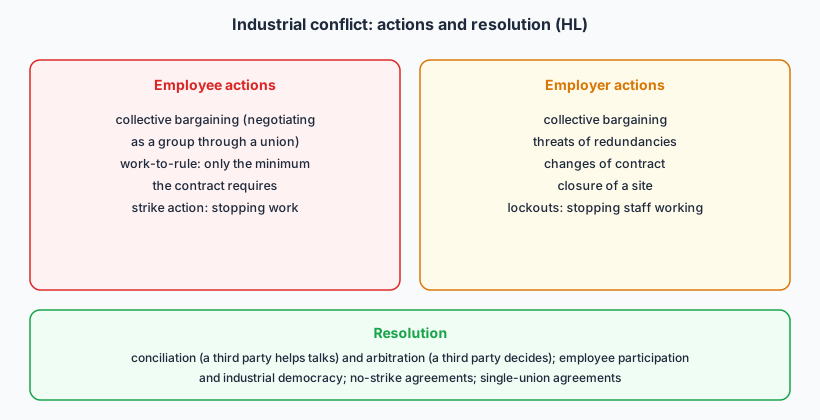
- Collective bargaining: negotiation between union representatives and management over pay and conditions for a whole group of workers. The normal, constructive first step.
- Work-to-rule: employees follow their contracts and rules exactly, refusing overtime and goodwill tasks. Output falls, but workers are still paid; hard for employers to discipline.
- Strike action: employees stop working. The strongest pressure, but workers lose pay, may lose jobs, and public support may fall; costly for both sides.
Employer approaches
- Collective bargaining: offering a negotiated deal.
- Threats of redundancies: warning that demands will cost jobs; pressures workers, but can damage morale and trust.
- Changes of contract: altering terms (hours, pay structure), sometimes by offering new contracts; legal limits apply.
- Closure: closing a site or threatening to relocate. A last resort that destroys jobs and reputation.
- Lockouts: preventing employees from working (and being paid) until they accept terms.
The bargaining power of each side depends on: union membership and unity; how easily workers can be replaced; the state of the labour market; the firm’s financial position and stock levels; public opinion; and the law.
Resolving and preventing conflict
- Conciliation: an independent third party helps the two sides talk and find their own agreement (it does not impose a solution).
- Arbitration: an independent arbitrator hears both sides and decides; in binding arbitration, both agree in advance to accept the decision. Pendulum arbitration picks one side’s final offer, encouraging reasonable offers.
- Employee participation and industrial democracy: involving employees in decisions through works councils, employee directors on the board, quality circles and consultation. Builds trust and reduces conflict; slows decisions.
- No-strike agreement: the union agrees not to strike, usually in return for binding arbitration or improved terms. Gives employers stability; weakens the union’s ultimate weapon.
- Single-union agreement: the employer recognizes only one union to represent all staff. Simpler negotiations, no inter-union rivalry; employees have less choice.
✏️Worked example HL
The situation: the source is pay after inflation reduced real wages; the company’s threat to outsource raises the stakes. Work-to-rule slows deliveries during a busy season, damaging customer service.
Continued collective bargaining is cheapest if both sides move (for example 7% plus a productivity bonus); but trust is low after the outsourcing threat. Conciliation could restart talks with an independent person; it preserves both sides’ control of the outcome. Binding arbitration guarantees a resolution but each side risks an unfavourable decision. Outsourcing might cut costs but risks quality, loss of experienced drivers, reputation damage and legal disputes. Judgment: conciliation followed, if needed, by arbitration is the lowest-risk route, combined with employee participation in a longer-term pay and productivity agreement to prevent repeat conflict.
📝Practise
All HL.
1. [2 marks] Define the term collective bargaining.
2. [2 marks] Distinguish between work-to-rule and strike action.
3. [4 marks] Explain two factors that affect the bargaining power of a trade union.
4. [4 marks] Explain one advantage and one disadvantage for an employer of a single-union agreement.
5. [4 marks] Explain why a lockout is a risky tactic for an employer.
6. [10 marks] Evaluate employee participation as a way of reducing workplace conflict.
For: consultation builds trust and shared understanding; employees’ knowledge improves decisions; early involvement reduces resistance to change; works councils and employee directors give a voice before conflicts escalate.
Against: slower decisions; managers may treat it as a formality, causing cynicism; some decisions (redundancies) remain conflictual; costs of time and training; not all employees want to participate.
Judgment: effective as a preventive measure when genuine and supported by leadership; it complements rather than replaces collective bargaining and third-party resolution.
🔗Go deeper — other people’s work
These are external resources, not mine. If one stops working, tell me and everything above it on this page still stands.
- International Labour Organization (ILO) — conventions on freedom of association and collective bargaining.
- Acas (UK) — clear guides to conciliation, arbitration and workplace negotiation.
- News coverage of strikes in any industry — practise identifying the source, tactics and resolution.