The seven Ps of the marketing mix
🎯What you need to be able to do
- Explain the relationship between the product life cycle, the product portfolio and the marketing mix; evaluate extension strategies; explain the link between the life cycle, investment, profit and cash flow.
- Explain branding (awareness, development, loyalty, value) and its importance.
- Evaluate cost-plus, penetration, loss leader, predatory and premium pricing; HL dynamic, competitive and contribution pricing and price elasticity of demand.
- Evaluate above-the-line, below-the-line and through-the-line promotion, and social media marketing.
- Evaluate distribution channels; the importance of people, processes and physical evidence for services; and appropriate marketing mixes.
📚The business management
Product: the product life cycle
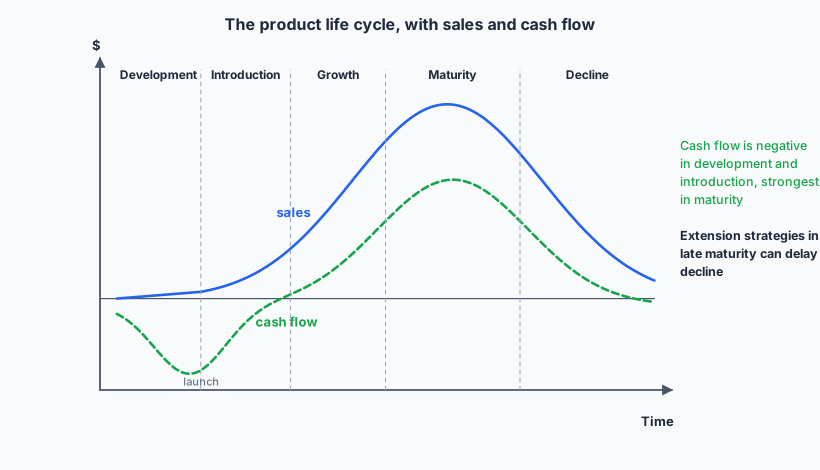
- Development: research, design and testing; no sales; heavy spending, negative cash flow.
- Introduction: launch; low sales, high promotion costs; usually losses; limited distribution.
- Growth: sales rise quickly; profits begin; competitors enter; expand distribution.
- Maturity: sales peak and level off; strong cash flow and profit; intense competition; focus on differentiation.
- Decline: sales fall as tastes change or new products appear; decide whether to extend, milk (cut spending, keep collecting cash) or withdraw.
Life cycle, investment, profit and cash flow: investment is highest before and at launch, when cash flow is negative; profit and cash flow peak in maturity; that surplus funds the development of new products. A firm needs products at different stages: its product portfolio should balance products that use cash (new) with those that generate it (mature); the BCG matrix analyses this.
Extension strategies lengthen the maturity stage and delay decline: new versions or flavours, new packaging, new target markets (new segments or countries), new uses, price reductions, fresh promotion, bundling.
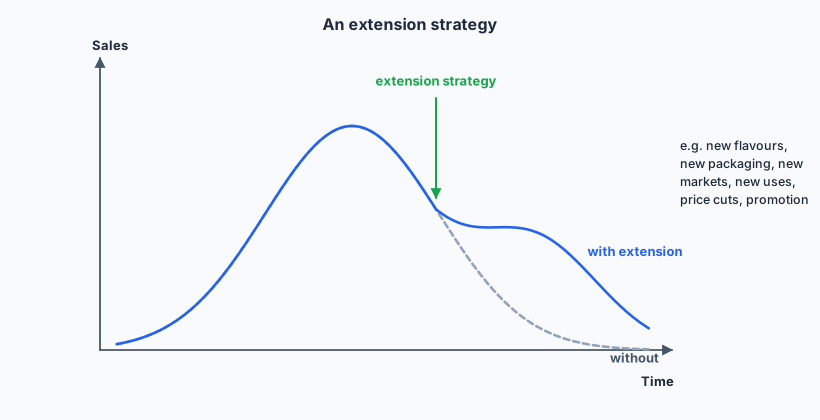
Extension strategies cost money and may only delay the inevitable; sometimes resources are better spent on new products.
Product: branding
A brand is a name, symbol, design or image that identifies a product and distinguishes it from competitors.
- Brand awareness: how far consumers recognize and recall the brand.
- Brand development: building and extending the brand: new products under the same name, new markets, stronger identity.
- Brand loyalty: customers repeatedly choose the brand, even when alternatives are cheaper.
- Brand value: the extra value the brand adds: the premium customers will pay because of the name (brand equity).
Importance: allows premium pricing, creates loyalty and repeat sales, makes new products easier to launch, reduces price sensitivity, and becomes a valuable intangible asset. Risks: expensive to build, easily damaged by scandals or poor quality.
Price
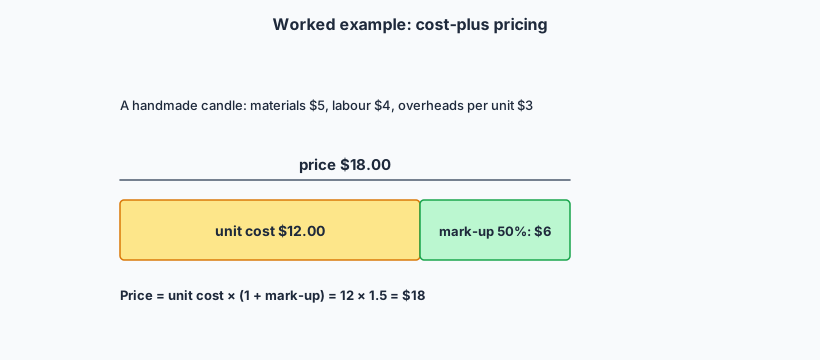
- Cost-plus (mark-up) pricing: unit cost plus a percentage mark-up. Simple and covers costs; ignores demand and competitors.
- Penetration pricing: a low price to enter a market and win share quickly, raised later. Builds market share; low early profits; customers may resist later rises.
- Loss leader: selling one product below cost to attract customers who buy other, profitable products (supermarket staples; printers sold cheaply with expensive ink).
- Predatory pricing: pricing below cost to drive competitors out, then raising prices. Anti-competitive and illegal in many countries.
- Premium pricing: a high price reflecting exclusivity, quality or brand image. High margins; small market; must be justified by brand and quality.
- HL Dynamic pricing: prices change in real time with demand (airlines, hotels, ride-hailing surge pricing). Maximizes revenue; can seem unfair to customers.
- HL Competitive pricing: set in relation to competitors’ prices (at, below or slightly above). Common in markets with similar products; ignores own costs.
- HL Contribution pricing: any price above variable cost per unit contributes to fixed costs; used for special orders or spare capacity (toolkit).
- HL Price elasticity of demand (PED): the responsiveness of quantity demanded to a price change: PED = %ΔQd ÷ %ΔP. If demand is price inelastic (|PED| < 1), raising price raises revenue; if elastic (|PED| > 1), lowering price raises revenue.
Promotion
paid mass-media advertising through independent media: TV, radio, newspapers, cinema, billboards, broad online display ads. Wide reach and brand awareness; expensive, hard to target and measure.
promotion the business controls directly and targets closely: sales promotions (discounts, buy-one-get-one), direct marketing, sponsorship, public relations, trade fairs, packaging, loyalty schemes. Targeted and measurable; smaller reach.
an integrated campaign combining ATL and BTL, for example a TV ad driving people to a website offer or in-store event.
Social media marketing promotes products through platforms such as Instagram, TikTok, YouTube and Facebook: organic posts, paid targeted ads, influencer marketing and user-generated content. Advantages: low cost, precise targeting by interests and location, two-way engagement, measurable results, content can go viral. Disadvantages: negative comments spread fast; needs constant content; algorithm changes; influencer fraud and authenticity concerns; saturation.
Place (distribution)
Distribution channels are the routes from producer to consumer:
- Zero-level (direct): producer → consumer (own shop, own website, farmers’ market). Control and higher margin; limited reach.
- One-level: producer → retailer → consumer (minimarket chains, online marketplaces).
- Two-level: producer → wholesaler → retailer → consumer (common for FMCG in Indonesia’s many small warungs).
- Agents and distributors for international markets.
More intermediaries give wider reach but lower margins and less control. Omnichannel retailing combines physical and online channels.
People, processes and physical evidence (services)
- People: employees are part of the service; their knowledge, attitude and appearance shape the customer’s experience, so recruitment, training and motivation matter. Expected employee–customer relationships vary between cultures (formality, warmth, directness).
- Processes: the systems by which the service is delivered: booking, waiting times, payment, delivery. Efficient, reliable processes (and changes such as online check-in and QR ordering) improve satisfaction.
- Physical evidence: tangible cues that reassure customers about an intangible service: the building, decor, cleanliness, uniforms, website design, brochures, reviews and certificates.
Appropriate marketing mixes
The Ps must be consistent with each other and with the target market and positioning: a premium spa needs premium price, calm physical evidence, highly trained people and exclusive promotion; a budget hostel needs a low price, efficient online processes and social media promotion. The mix changes over the product life cycle (heavy promotion at launch, extension strategies in maturity) and between markets.
✏️Worked example
(a) Unit cost = 5 + 4 + 3 = $12. Price = 12 × 1.5 = $18.
(b) %ΔP = 2 ÷ 18 × 100 = 11.1%; %ΔQ = −20 ÷ 400 × 100 = −5%. PED = −5 ÷ 11.1 = −0.45: price inelastic. Revenue rose from 7200 to 7600, so the higher price is worthwhile if costs stay the same.
(c) Product: natural soy wax with Balinese scents (frangipani, sandalwood) and gift packaging telling the maker’s story. Price: premium, around $20, consistent with inelastic demand among tourists. Promotion: Instagram and TikTok content, tourist-guide partnerships, in-store demonstrations (BTL). Place: own workshop shop plus boutique hotels and gift shops; an online store for repeat orders from abroad. The mix is consistent with a premium, gift-oriented positioning.
📝Practise
Work through these on paper, then reveal the answer.
1. [2 marks] Define the term extension strategy.
2. [2 marks] Distinguish between above-the-line and below-the-line promotion.
3. [4 marks] Explain why a new streaming service might use penetration pricing.
4. HL [3 marks] A hotel cuts its room rate from $100 to $90 and bookings rise from 500 to 600 a month. Calculate PED and the change in revenue.
5. [4 marks] Explain the importance of physical evidence for a dental clinic.
6. [10 marks] A long-established instant coffee brand is in the maturity stage with falling sales. Discuss the extension strategies it could use.
Options: new variants (low-sugar, iced, premium single-origin); new packaging (sachets for convenience stores, eco-refills); new segments (young adults via social media, office buyers); new markets abroad; new uses (recipes, ready-to-drink cans); promotion refresh and price promotions.
Evaluation: costs of R&D and marketing versus likely gains; cannibalization of existing sales; whether the decline is due to a lasting shift (towards fresh coffee shops) that extensions cannot reverse; brand strength to support new variants. Judgment: combine a product extension targeting the growing iced-coffee trend with digital promotion, while considering the brand’s long-term portfolio.
🔗Go deeper — other people’s work
These are external resources, not mine. If one stops working, tell me and everything above it on this page still stands.
- Interbrand — annual rankings of the world’s most valuable brands.
- Meta and TikTok business help centres — how targeted social media advertising works.
- Tutor2u — revision notes on the marketing mix and pricing.