Introduction to operations management
🎯What you need to be able to do
- Explain the role of operations management.
📚The business management
The role of operations management
Operations management is the planning, organizing and controlling of the processes that transform inputs into outputs: goods and services that meet customer needs. It applies to manufacturers (a garment factory), service businesses (a hotel, a bank, a hospital) and online businesses (an e-commerce warehouse).
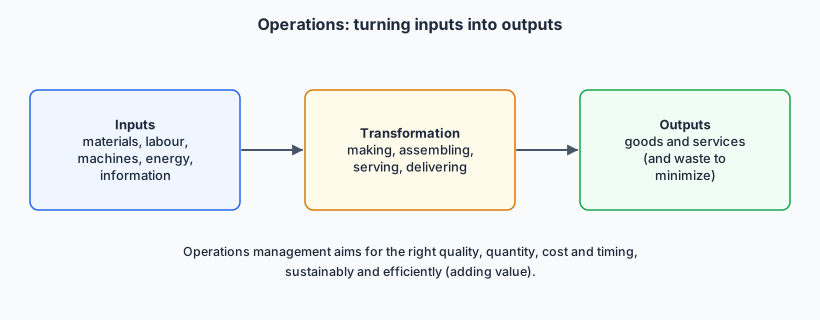
Operations objectives usually include:
- Quality: products that meet customer expectations and standards (5.3).
- Cost and efficiency: low unit costs through good use of resources, reducing waste.
- Speed and dependability: meeting delivery times reliably.
- Flexibility: adapting volume and variety to demand.
- Sustainability: using fewer resources and less energy, reducing waste and pollution, sourcing ethically; circular business models redesign operations around reuse and recycling.
Links with other functions
- Marketing forecasts demand, so operations plans capacity and stock; operations determines whether marketing’s promises (quality, delivery) can be kept.
- Finance funds equipment and stock; operations costs drive profit margins and cash flow.
- HR provides the skilled workforce and training operations needs; operations decisions (automation, lean) change jobs.
✏️Worked example
Inputs: ingredients, chefs and waiters, kitchen equipment, energy, recipes. Process: preparing, cooking and serving meals. Outputs: meals and the dining experience; waste (leftovers, packaging).
Changes: (1) replace a large buffet with smaller, cooked-to-order menus at quiet times, reducing unsold food; (2) track waste daily and adjust ordering (a lean, data-based approach), and compost unavoidable scraps for the resort garden (a circular model). Both cut costs and support a sustainability message to guests, but must not slow service at busy times.
📝Practise
Work through these on paper, then reveal the answer.
1. [2 marks] Define the term operations management.
2. [2 marks] Identify two inputs and one output for a ride-hailing company.
3. [4 marks] Explain two objectives of operations management for a hospital.
4. [4 marks] Explain how operations management links with marketing.
5. [4 marks] Explain one way operations management can make a business more sustainable.
6. [10 marks] Discuss the view that operations management is the most important function in a manufacturing business.
For: operations produces the product; it determines cost, quality and delivery, which drive competitiveness and profit.
Against: without marketing, products may not sell; without finance, operations cannot be funded; without HR, there is no skilled workforce; the functions are interdependent.
Judgment: operations is central in manufacturing, but success depends on integration; its importance varies with the strategy (cost leadership places more weight on operations; a differentiated brand on marketing).
🔗Go deeper — other people’s work
These are external resources, not mine. If one stops working, tell me and everything above it on this page still stands.
- Nigel Slack, Operations Management — a standard textbook.
- Ellen MacArthur Foundation — circular economy examples in operations.
- Tutor2u — revision notes on operations.