Operations methods
🎯What you need to be able to do
- Evaluate job production, batch production, mass/flow production and mass customization.
📚The business management
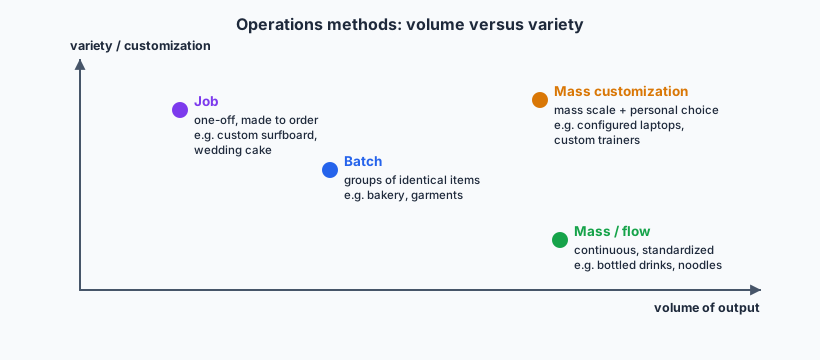
Job production
A single, unique product made to a customer’s specification: a custom surfboard, a wedding dress, a building, a bespoke website.
meets exact customer needs; high quality; premium prices; motivating, skilled work; flexible.
high unit costs; slow; needs skilled labour; no economies of scale; demand can be irregular.
Batch production
A group of identical items is produced together, then the process switches to another batch: a bakery making trays of one bread then another, garment factories making a style in several sizes.
some economies of scale; more variety than mass production; flexible to demand.
idle time and cost when switching between batches (cleaning, resetting machines); stock of work in progress to store; repetitive work.
Mass / flow production
Continuous production of large quantities of standardized products on a production line: soft drinks, instant noodles, cement, smartphones.
very low unit costs through economies of scale and automation; consistent quality; high output.
huge capital cost; inflexible (hard to change the product); repetitive, demotivating work; a breakdown stops the whole line; needs large, stable demand.
Mass customization
Combining the low cost of mass production with individual customization, using flexible technology and digital ordering: laptops configured online, personalized trainers, custom-printed products, meal kits chosen by each customer.
customer choice at near-mass-production costs; higher prices and loyalty; production to order reduces unsold stock.
needs advanced technology and flexible supply chains; complex logistics; longer delivery times than off-the-shelf.
Choosing a method
Depends on: the size and stability of demand; the product (unique or standardized); customer expectations; available finance and technology; the skills of the workforce; and the business’s strategy (cost leadership vs differentiation). Many businesses combine methods: a bakery may mass-produce bread but make celebration cakes to order.
✏️Worked example
For: beginner boards are standardized, so making them in batches of 20 lowers unit costs through bulk materials and repeated set-ups; faster delivery to surf schools; frees skilled shapers for premium custom boards.
Against: needs moulds and space; stock of unsold boards if demand falls; the brand’s handmade image may weaken; staff may find repetitive work demotivating.
Judgment: adding batch production for a separate beginner range is sensible if demand is reliable (for example, contracts with surf schools), while keeping job production for the premium brand.
📝Practise
Work through these on paper, then reveal the answer.
1. [2 marks] Define the term batch production.
2. [2 marks] Distinguish between job production and mass customization.
3. [4 marks] Explain two disadvantages of flow production.
4. [4 marks] Explain why a wedding-dress designer uses job production.
5. [4 marks] Explain how mass customization can reduce stock costs.
6. [10 marks] Discuss whether a growing craft-beer brewery should move from batch to flow production.
For: lower unit costs, higher capacity to supply supermarkets, consistent quality, economies of scale.
Against: large investment and risk; loss of variety and seasonal specials that define craft brands; demand may not be large or stable enough; staff skills and motivation.
Judgment: depends on demand forecasts and strategy; a hybrid (flow for core beers, batch for specials) often suits craft brewers.
🔗Go deeper — other people’s work
These are external resources, not mine. If one stops working, tell me and everything above it on this page still stands.
- Factory tour videos from manufacturers — see flow production in action.
- Harvard Business Review — articles on mass customization.
- Tutor2u — production methods revision.