Lean production and quality management
🎯What you need to be able to do
- HL Describe the features of lean production: less waste, greater efficiency.
- HL Explain continuous improvement (kaizen) and just-in-time (JIT); the features of cradle-to-cradle design and manufacturing.
- HL Explain quality control and quality assurance; quality circles, benchmarking and total quality management (TQM).
- HL Evaluate the impact of lean production and TQM; explain the importance of national and international quality standards.
📚The business management
Lean production
Lean production, developed in Japanese manufacturing (notably Toyota), aims to minimize all forms of waste: overproduction, waiting, unnecessary transport and movement, excess stock, over-processing and defects. The results are greater efficiency, lower costs, faster production and often better quality.
Continuous improvement (kaizen)
Kaizen means making many small, ongoing improvements, suggested by all employees, rather than relying on occasional big changes. Workers closest to the process spot problems and fix them.
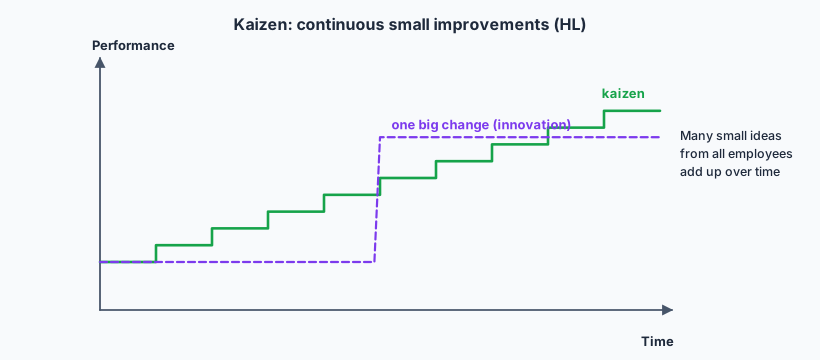
Benefits: cheap, motivating (empowerment), gains accumulate. Limitations: needs a supportive culture and trust; small steps may not be enough when the market needs radical change; staff may run out of ideas or feel pressured.
Just-in-time (JIT)
JIT means receiving materials and producing goods only when they are needed, so stock of materials, work in progress and finished goods is minimal. Benefits: less money tied up in stock, less storage space and waste, problems exposed quickly. Limitations: needs reliable suppliers, excellent communication and predictable demand; any disruption stops production (as many car makers found in the 2021 semiconductor shortage); frequent small deliveries can cost more and lose bulk discounts. Compare with just-in-case (5.6).
Cradle-to-cradle design
Cradle-to-cradle design and manufacturing plans products so that, at the end of their life, all materials are either returned safely to nature (biodegradable) or fully reused as inputs for new products, with no waste. It contrasts with “cradle to grave”, where products end in landfill. Features: safe, non-toxic materials; designed for disassembly; renewable energy; water stewardship. It fits circular business models (toolkit) but requires redesign and new supply chains.
Quality control and quality assurance
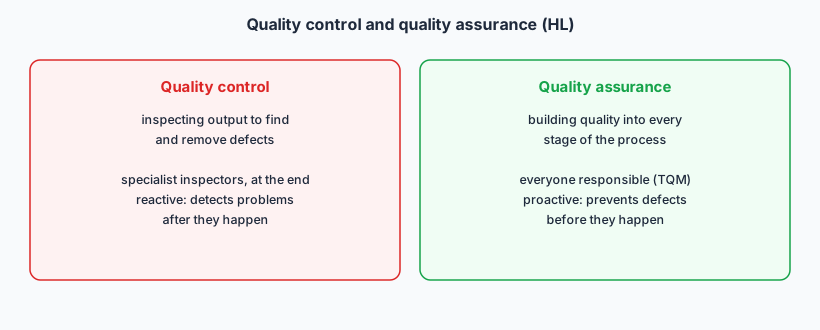
Methods of managing quality
- Quality circles: small groups of workers who meet regularly to identify and solve quality problems in their area. Uses workers’ knowledge and motivates; needs time and management support.
- Benchmarking: comparing the business’s processes and performance with the best in the industry (or other industries) and adopting best practice. Sets clear targets; data may be hard to obtain; copying may not fit.
- Total quality management (TQM): an organization-wide culture in which every employee is responsible for quality at every stage, aiming for zero defects and continuous customer satisfaction; “internal customers” (the next process) also matter.
Impact of lean production and TQM
lower costs and waste; better quality and fewer returns; faster response; more motivated, empowered workers; stronger reputation and competitiveness; environmental benefits.
high initial training costs; requires cultural change and commitment from management; stress from continuous pressure; supply-chain vulnerability with JIT; benefits take time.
Quality standards
National and international quality standards certify that a business meets agreed standards: the ISO 9000 family (quality management), ISO 14001 (environmental management), Indonesia’s SNI national standard, halal certification, food safety standards. Importance: customer and business-customer confidence; often required to sell to large firms, governments or export markets; reduces risk; marketing value. Drawbacks: costly and bureaucratic to obtain and maintain; certify the process, not necessarily the product’s excellence.
✏️Worked example HL
TQM: training every worker to check their own work and quality circles to fix recurring problems should cut defects at source, reducing rework and returns, and may help gain ISO certification the retailer values. Costs: training, time and a change in culture from blame to problem-solving.
JIT fabric: frees cash and space, but fabric often comes from overseas mills with long, uncertain lead times; a delayed shipment could stop production and miss the retailer’s deadlines.
Judgment: adopt TQM first, since quality is the retailer’s priority; use JIT only for fabric sourced from reliable local suppliers and keep a buffer for imported fabric.
📝Practise
All HL.
1. [2 marks] Define the term kaizen.
2. [2 marks] Distinguish between quality control and quality assurance.
3. [4 marks] Explain two benefits of just-in-time production.
4. [4 marks] Explain how benchmarking could help a hotel improve quality.
5. [4 marks] Explain why ISO certification might matter to a small supplier of car parts.
6. [10 marks] Discuss the impact of adopting lean production on a company’s stakeholders.
Shareholders: lower costs, higher margins (long-term). Employees: empowerment and teamwork, but pressure, possible job cuts from efficiency, need for training. Customers: better quality and faster delivery. Suppliers: must deliver frequently and reliably, closer relationships. Environment: less waste. Community: jobs may fall.
Judgment: generally positive if introduced with consultation and training; risks from supply disruption and staff resistance must be managed.
🔗Go deeper — other people’s work
These are external resources, not mine. If one stops working, tell me and everything above it on this page still stands.
- Toyota Global — the Toyota Production System explained.
- ISO — overview of ISO 9001 and ISO 14001.
- Cradle to Cradle Products Innovation Institute — examples of certified products.