Location
🎯What you need to be able to do
- Explain the reasons for a specific location of production.
- Evaluate outsourcing/subcontracting, offshoring, insourcing and reshoring.
📚The business management
Reasons for a location
Quantitative factors (measurable):
- Cost of land and premises (rent, purchase).
- Labour: cost, availability and skills.
- Transport costs: closeness to raw materials (for bulky or perishable inputs, such as a palm oil mill near plantations) or to customers (for services and fragile products).
- Government incentives: tax breaks and grants in special economic zones or less developed regions.
- Infrastructure: roads, ports, airports, power, internet.
Qualitative factors:
- Quality of life for managers and staff; local culture and attitudes.
- Political stability, corruption, legal system.
- Planning regulations and environmental rules.
- Clustering: being near suppliers and similar firms (external economies of scale, 1.5).
- Image: a Bali address for a surf brand; a Swiss address for watches.
For services such as hotels and shops, location near customers (footfall, tourist areas) usually dominates.
Reorganizing production
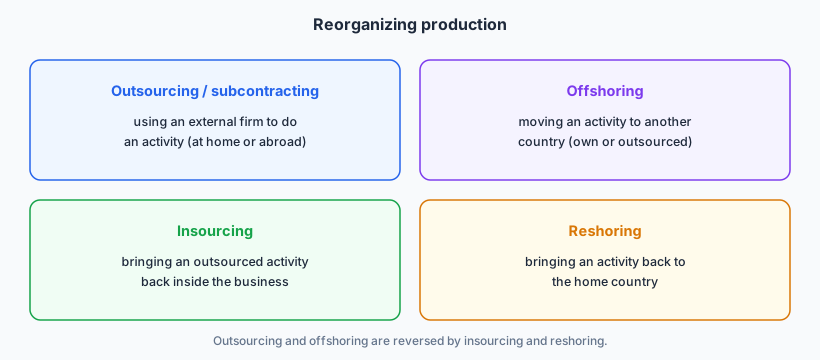
lower costs, access to specialists, focus on core activities, flexibility. But: less control over quality and deadlines, risk of leaked know-how, dependence on the supplier, job losses and poor morale internally.
lower labour and operating costs, closeness to new markets, 24-hour operations across time zones. But: communication, cultural and quality problems, longer supply chains, political and exchange-rate risk, reputation damage if conditions are poor.
regains control of quality and data, protects know-how, may respond faster. But: higher costs, need to recruit and train staff and invest in equipment.
shorter, more resilient supply chains, faster delivery, “made at home” marketing, government incentives. But: higher labour costs, skills shortages; driven since the pandemic and trade tensions by supply-chain risk.
✏️Worked example
For: shorter lead times to its main market, faster response to trends; closer control of quality and working conditions, protecting the brand; lower transport costs and emissions; “made in Indonesia” appeal; Central Java has garment clusters with skilled workers and lower wages than Jakarta.
Against: costs may be higher than the cheapest foreign factories; investment or new contracts needed; capacity and specialist skills may be limited; its export customers may still be better served from elsewhere.
Judgment: reshoring core, fast-changing lines while keeping some offshore suppliers for basic items balances cost with control and resilience.
📝Practise
Work through these on paper, then reveal the answer.
1. [2 marks] Define the term outsourcing.
2. [2 marks] Distinguish between offshoring and reshoring.
3. [4 marks] Explain two factors a hotel group would consider when choosing a location.
4. [4 marks] Explain one advantage and one disadvantage of outsourcing customer service to a call centre company.
5. [4 marks] Explain why a palm oil mill is usually located close to plantations.
6. [10 marks] Discuss whether a software company should offshore its programming work.
For: lower labour costs, access to a large pool of developers, round-the-clock work across time zones.
Against: communication and cultural barriers, time-zone coordination, quality and security risks, intellectual property protection, loss of in-house knowledge, local staff morale.
Judgment: suitable for well-specified tasks with strong project management; core development and sensitive data may be better kept in-house.
🔗Go deeper — other people’s work
These are external resources, not mine. If one stops working, tell me and everything above it on this page still stands.
- Kawasan Ekonomi Khusus (Indonesia’s special economic zones) — incentives for investors.
- Harvard Business Review — articles on reshoring and supply-chain resilience.
- Tutor2u — location decisions revision.