Management information systems
🎯What you need to be able to do
- HL Describe data analytics, databases, cybersecurity and cybercrime, and critical infrastructure (such as AI, big data, cloud computing, virtual reality and the internet of things).
- HL Explain how customer loyalty programmes and digital Taylorism use data.
- HL Evaluate the benefits and risks of data mining on businesses and customers, and how data can inform decision-making.
- HL Discuss the ethical implications of using data and technology in business.
📚The business management
Key terms
- Management information system (MIS): the people, technology and processes that collect, store and present information to help managers decide.
- Data analytics: examining data to find patterns, trends and relationships (which products sell together, when demand peaks).
- Database: an organized store of data (customers, stock, staff) that can be searched, sorted and updated.
- Cybersecurity: protecting systems, networks and data from attack. Cybercrime: crime using computers, such as hacking, ransomware, phishing and data theft.
- Critical infrastructure: the technology a business depends on, such as cloud computing (renting storage and software over the internet), the internet of things (IoT) (connected sensors and devices), virtual reality, AI and big data.
- Artificial intelligence (AI): computer systems that perform tasks normally needing human intelligence: recognizing images, understanding language, predicting demand, recommending products.
- Big data: data sets so large, fast-changing and varied (volume, velocity, variety) that ordinary tools cannot handle them.
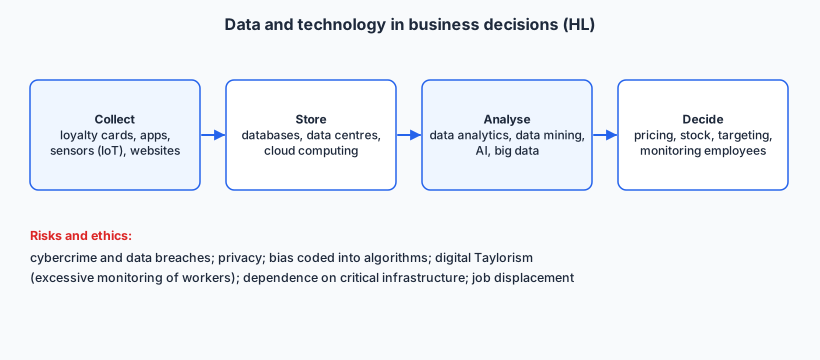
Loyalty programmes and digital Taylorism
Customer loyalty programmes (points cards, app rewards) give customers discounts in exchange for repeat purchases and their data. The business learns what, when and where each customer buys, and uses it for personalized offers, stock planning and pricing. Costs include the rewards themselves and the system; customers may join several schemes, so loyalty is not guaranteed.
Digital Taylorism applies F. W. Taylor’s scientific management (2.4) with technology: tracking workers’ keystrokes, delivery times, calls handled or warehouse picks, and setting targets from the data. It can raise productivity and consistency, but reduces autonomy and trust, raises stress and privacy concerns, and can demotivate skilled staff.
Data mining: benefits and risks
Data mining is searching large data sets to discover hidden patterns and predict behaviour.
better targeted marketing and higher sales; accurate demand forecasts and less waste; fraud detection; personalized service for customers; faster, evidence-based decisions.
privacy invasion and loss of trust; data breaches and legal penalties; costly systems and specialist staff; wrong conclusions from poor data or mistaking correlation for cause; customers feeling manipulated.
Ethical implications
- Privacy and consent: do customers know what is collected and how it is used? Laws such as Indonesia’s Personal Data Protection Law (2022) and the EU’s GDPR set rules.
- Bias: algorithms trained on biased data can discriminate in hiring, lending or pricing.
- Surveillance of employees (digital Taylorism) and job displacement by AI and automation.
- Security: a duty to protect data from cybercrime.
- Manipulation: personalized prices or persuasive design that exploit customers.
✏️Worked example
Benefits: data on every shopper enables personalized promotions (raising basket size), better stock forecasts by store (less food waste), smarter pricing and store layouts; rewards encourage repeat visits in a competitive market.
Risks: app and AI costs; skills needed to analyse data; cyberattacks exposing customers’ data, with penalties under the data protection law and reputational harm; customers uneasy about tracking; rivals offering similar schemes, so rewards become a cost of doing business.
Judgment: worthwhile if data is collected with clear consent, secured properly, and used to give customers real value; otherwise the loss of trust could outweigh the gains.
📝Practise
Work through these on paper, then reveal the answer.
1. [2 marks] Define the term big data.
2. [2 marks] Define the term digital Taylorism.
3. [4 marks] Explain two ways a hotel could use data analytics.
4. [4 marks] Explain two risks to a business of relying on cloud computing.
5. [10 marks] Discuss the ethical implications of a delivery company using AI to monitor and set targets for its drivers.
Benefits: efficient routes, faster deliveries, lower fuel use, fair targets based on data, safer driving through alerts.
Ethical concerns: constant surveillance and loss of privacy; stress and unsafe driving to hit targets; algorithms ignoring context (traffic, weather); bias in ratings; lack of transparency about how targets are set; reduced autonomy and motivation (Herzberg, self-determination theory).
Judgment: acceptable only with transparency, consent, human review of decisions and realistic targets; otherwise it harms staff welfare, raises labour turnover and damages the brand.
🔗Go deeper — other people’s work
These are external resources, not mine. If one stops working, tell me and everything above it on this page still stands.
- Indonesia’s Personal Data Protection Law (UU PDP No. 27/2022) — summaries by law firms and Kominfo.
- BSSN (Indonesia’s National Cyber and Crypto Agency) — cybersecurity guidance.
- Harvard Business Review — articles on data ethics and algorithmic management.